On Wednesday afternoon, I was checking the parameters of another groundwater monitoring well when a third-party testing company from Shanxi sent me an inquiry.
The customer wanted to purchase three types of groundwater sampling equipment from AIMOLI: one multiparameter meter, one groundwater sampling pump, and one well depth and water level meter, one unit of each.
A parameter sheet was attached to the inquiry.
I opened it and looked through it twice. There were indeed only three lines of information, without even a table header.
There was no information about the depth or diameter of the monitoring well, no description of the aquifer conditions, and no mention of whether the monitoring project involved volatile organic compounds (VOCs). There was also no information about sampling frequency or the specific technical standards to be followed.
At the end, there was only one sentence: Please provide a quotation. Can the total budget be kept within RMB 20,000?
I did not immediately open the price list.
Compared with the quotation, I was more concerned about something else: Would the customer be able to complete the internal approval process smoothly with this procurement plan?
For a third-party testing company, purchasing equipment is not simply a matter of buying something that can be used. The company also needs to explain the procurement basis to the project owner, undergo project reviews, and take responsibility for the final testing reports.
If a procurement plan only contains equipment models and prices, without corresponding technical justification, it will obviously be unable to answer questions from reviewers about well purging records, on-site parameter measurements, and whether the sampling procedures comply with the relevant standards.
At that point, another thought crossed my mind: This inquiry was simply too brief. It looked a little like a form specifically prepared for comparing quotations from different suppliers.
It only asked about models and prices, without providing specific working conditions or discussing actual application requirements. With such information, it would certainly be easy to collect quotations from several suppliers and compare them side by side.
Of course, it was also possible that someone simply wanted to understand market prices or find out how much room suppliers had for negotiation.
After working in this industry for so many years, I have had similar thoughts when receiving inquiries like this.
However, the thought soon passed.
I had no need to guess the customer’s real intentions, and I certainly would not change the way I treated the customer based on my own assumptions.
If the other party was a genuine customer with purchasing needs, I did not want to lose a potential business opportunity because of an inappropriate question. Even if the other party was simply researching market prices, I should still provide the professional information I could offer honestly.
Rather than spending time guessing what the customer was thinking, I preferred to focus on doing what needed to be done.
I poured myself a glass of water and closed the price list.
It was not that I refused to provide a quotation. It was simply not the right time to do so.
I did not want to dismiss the customer with a simple statement that the budget was insufficient. Nor did I want to put together an equipment configuration just to keep the total price within RMB 20,000 and encourage the customer to place an order quickly.
That figure might look attractive, but groundwater sampling is not a job that can be completed simply by purchasing a few instruments.
If the subsequent project review involved requirements for low-flow purging, continuous stable readings of field parameters, and other technical procedures, but the equipment configuration could not meet the actual working requirements, the additional costs the customer eventually faced could be far greater than the money saved during the initial purchase.
By that time, if the customer asked me, “Why didn’t you mention these issues earlier?”, the solution would certainly not be as simple as purchasing one additional piece of equipment.
So I found three documents and sent them to the customer.
The first was HJ 164-2020, Technical Specifications for Environmental Monitoring of Groundwater. This standard was issued under Announcement No. 57 of 2020 by the Ministry of Ecology and Environment of China. It came into effect on March 1, 2021, replacing the previous standard HJ/T 164-2004.
The second was HJ 1019-2019, Technical Guidelines for Sampling of Volatile Organic Compounds in Soil and Groundwater at Contaminated Sites, which came into effect on September 1, 2019.
The third was AIMOLI’s groundwater sampling equipment product catalog.
After sending the documents, I added another message:
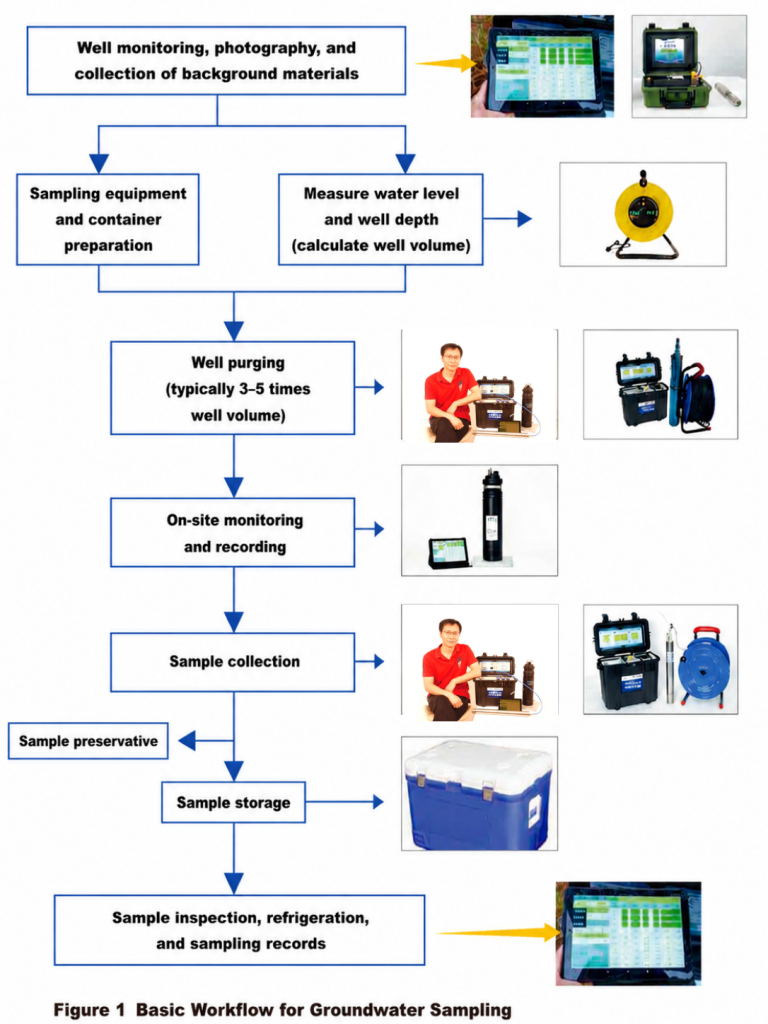
“The three types of equipment you inquired about are among the field equipment configurations involved in the sampling preparation process under HJ 164-2020. We can first refer to the relevant standards to determine what tasks the project needs to complete, and then select the appropriate equipment models based on the actual well conditions and monitoring requirements. Rather than working backward from the budget to determine the configuration, it is better to start with the actual operational requirements. Groundwater monitoring is work governed by specific technical standards. It is not simply a matter of pumping a bucket of water out of a well.”
The conversation became noticeably slower after that.
We began discussing the specific sampling requirements one by one.
I explained to the customer that, according to the relevant requirements for low-flow sampling, well purging needs to be carried out before sampling. The water level drawdown should be controlled within the specified range, generally no more than 0.1 meters. At the same time, field parameters such as pH, electrical conductivity, and turbidity need to be continuously monitored. Sampling can only begin after the criteria for three consecutive stable readings have been met.
If the monitoring project involves VOCs, the relevant requirements of HJ 1019-2019 must also be followed. VOC samples should be collected first, no headspace should be left in the sample bottles, and centrifugal pumps cannot be used for collecting these types of samples.
In addition, field parameters such as pH, water temperature, turbidity, and electrical conductivity should be measured promptly at the water outlet on site, rather than being taken back to the laboratory for later measurement.
During our discussion, we also cleared up a minor misunderstanding.
The customer seemed to associate bailers with low-cost, makeshift sampling methods.
In fact, Appendix C of HJ 164-2020 also addresses the use of bailers. The key issue is not whether a bailer is used, but whether the operating procedure complies with the requirements.
For example, during sampling, the bailer should be positioned near the middle of the well screen, lowered and raised slowly, and used in a way that minimizes disturbance to the water inside the well. At the same time, air should be prevented from entering and causing aeration or other effects.
The real concern has never been the equipment itself, but whether the entire sampling process is carried out properly.
Rapid lowering and raising, skipping necessary well purging procedures, and failing to record three consecutive stable field parameter readings are the kinds of issues that may affect sampling quality and data reliability.
As the conversation continued, I did not give the customer any more general lectures. Instead, I shared several situations I had encountered in actual projects.
In one case, the flow rate of the sampling pump used by a customer was unstable, making it impossible to meet the operational requirements for low-flow purging. As a result, during project acceptance, the project owner questioned the representativeness of the samples. The team subsequently had to conduct additional testing, repeat the sampling, and revise the testing report. The additional costs were far greater than the price difference they had originally saved when purchasing the equipment.
I had also seen another situation in which a sampling team relied entirely on bailers to complete its work. Every time, the bailers had to be lowered and raised slowly. After a full day of work, the team could only complete sampling at one or two wells. The costs of vehicles, personnel, and time were all allocated across a very limited amount of work, naturally affecting project efficiency.
There were also some disposable consumables that appeared to be very inexpensive. They could indeed save a little money at the time of purchase. However, after completing three or four projects, the purchasing receipts had accumulated in a drawer. When the total was calculated, the accumulated expenses had already exceeded the amount originally saved.
I did not add a sentence such as “Therefore, you should purchase more expensive equipment” after sharing these examples.
A higher or lower equipment price does not directly determine whether the equipment is suitable for a project. It is enough to explain the actual problems encountered and the corresponding costs clearly, allowing the customer to make a judgment based on their own project requirements.
Two days later, the customer replied.
He said that he planned to study the two technical standards again, organize the specific conditions of the monitoring wells and the monitoring items, and then prepare a revised procurement plan and budget application that met the technical requirements.
At the end, he added another sentence:
“What our industry ultimately delivers is testing data. Equipment that can meet sampling requirements and stand up to project reviews is the equipment that truly saves money.”
Those were the customer’s own words.
I did not simply reply, “You’re absolutely right.” Instead, I told him:
“If you need to organize the well condition information, I have a well information checklist template here that I can send you for reference.”
After that, the conversation window remained quiet for the time being.
As for whether the order eventually went to AIMOLI, I did not specifically follow up to ask.
That afternoon, I still had the parameters of another well to check. I minimized the standards document I had opened and continued working on the tasks at hand.
After so many years in equipment sales, I have increasingly come to believe that when dealing with a purchasing inquiry, we should not only look at what the customer asks for, but also understand what problem the customer actually needs to solve.
What the customer purchases may be a pump, an instrument, or a set of sampling equipment. But what they ultimately need to deliver is a sampling process that meets the requirements, reliable testing data, and project results that can withstand inspection and review.
This is also what I have always insisted on: Before discussing prices, understand the customer’s actual needs. Before recommending equipment, understand the working environment in which that equipment will be used.
For AIMOLI, providing equipment is only the beginning of a partnership. Helping customers select the right equipment and ensuring that it is truly suitable for their actual work is what we value even more.
