1. Basic Process of Groundwater Sampling
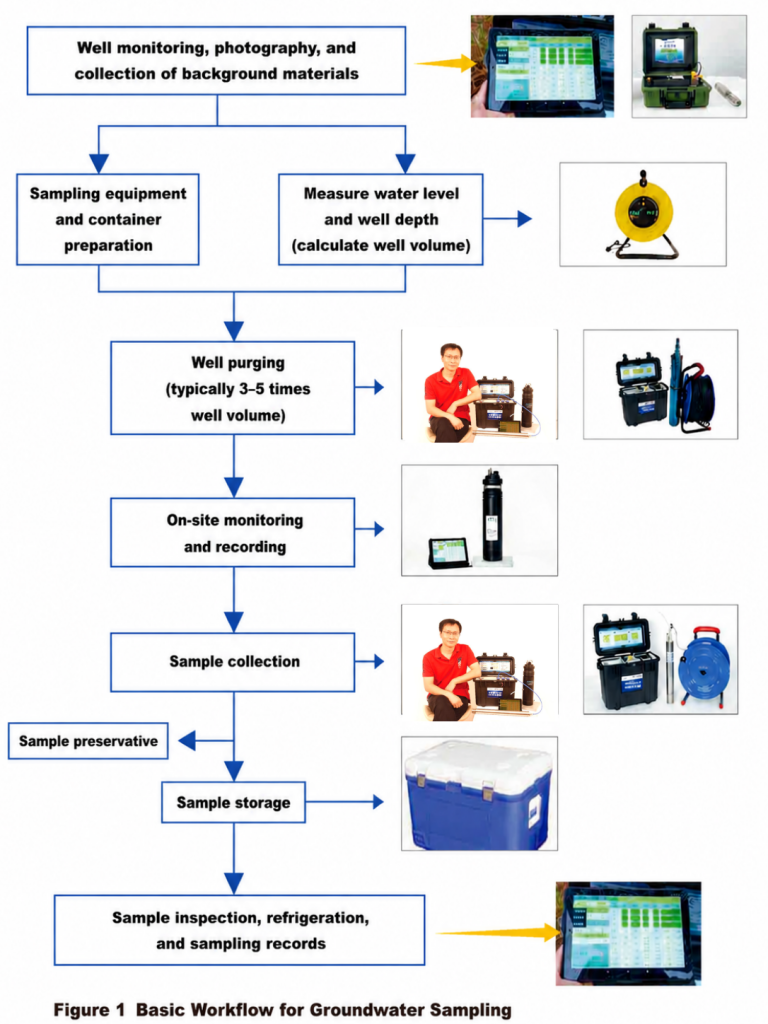
The basic process of groundwater sample collection is shown in Figure 1.
2. Measurement of Groundwater Level and Well Water Depth
(a) Groundwater quality monitoring usually requires the measurement of groundwater level (buried water level) and well water depth before sampling. The well water depth can be calculated using Formula (1):
Well water depth (m) = Depth from the bottom of the well to the wellhead – Distance from the groundwater surface to the wellhead.
(b) Groundwater level measurement mainly includes the measurement of static water level burial depth and elevation.
(c) When manually measuring the water level, measuring tools such as cloth tape measures, steel tape measures, or measuring ropes should be used to measure the vertical distance from the fixed point at the wellhead to the groundwater surface. The measurement is considered qualified when the difference between two consecutive static water level measurements is within ±1 cm/10 m; otherwise, the measurement should be repeated.
(d) In areas with suitable conditions, automatic water level recorders, electronic water level meters, or groundwater multi-parameter automatic monitoring instruments can be used for water level measurement.
(e) Water level measurement results should be recorded in meters (m), with values retained to two decimal places.
(f) Each time the water level is measured, records should be made regarding whether the monitoring well has previously been pumped and whether it has been affected by pumping from nearby wells.
3. Well Purging Before Groundwater Sampling
Before sampling, the well must be purged. Well purging should comply with the relevant requirements of HJ25.2 and HJ1019.
A portable water quality analyzer should be used onsite to measure the discharged water. Well purging can be terminated when any of the following conditions are met:
- Turbidity is less than or equal to 10 NTU;
- The variation in turbidity over three consecutive measurements is within ±10%;
- The variation in electrical conductivity over three consecutive measurements is within ±10%;
- The variation in pH over three consecutive measurements is within ±0.1;
- Or the volume of extracted water reaches 3–5 times the volume of water contained in the well.
4. Groundwater Sampling Methods
The existing pipeline monitoring well sampling method is applicable to monitoring wells that already have water extraction pipelines connected above ground. The conventional monitoring well sampling method is applicable to routine monitoring wells. The deep/large-diameter monitoring well micro-purge method is applicable to deep groundwater sampling.
If instruments and equipment of the same type are unavailable, equivalent instruments and equipment recognized by national or international standards may be used.
During the sampling process, recommended sampling methods may be selected according to actual conditions. Other sampling methods that meet quality control requirements may also be adopted based on field conditions.
5. Groundwater Sample Collection
Samples are generally collected in the following order:
Volatile Organic Compounds (VOCs), Semi-Volatile Organic Compounds (SVOCs), Stable Organic Compounds and Microbiological Samples, Heavy Metals, and General Inorganic Compounds.
When collecting VOC water samples, the relevant requirements of HJ1019 shall be followed. When collecting SVOC water samples, the flow rate at the outlet should be controlled between 0.2 L/min and 0.5 L/min. For other monitoring project samples, the outlet flow rate should be controlled below 1 L/min. If water quality is likely to undergo significant changes during sampling, the sampling flow rate may be appropriately increased.
(a) Groundwater samples should generally be collected as clear water samples. If the water sample is turbid, further well purging should be conducted to ensure that the monitoring well discharge water is clear and free of sand.
(b) During sampling, except for projects with special requirements, the sampler and water sample containers should be rinsed 2–3 times with the collected water sample before use. When collecting VOC water samples, the container must be completely filled without leaving any headspace. Specific requirements should refer to HJ1019. Water samples for sulfide, petroleum, bacterial, radioactive, and other analyses should be collected separately. The required sample volumes for each monitoring project are provided in Appendix D. The sampling volumes listed in Appendix D have considered the requirements for duplicate analysis and quality control, with sufficient allowance.
(c) After collecting the water sample, immediately tighten and seal the bottle cap, and attach the label. The label can be designed according to specific requirements and generally includes sampling date and time, sample number, monitoring items, etc.
(d) Before completing the sampling process, the sampling plan, sampling records, and water samples should be checked. If any errors or missing samples are found, resampling or supplementary sampling should be conducted immediately.
6. Cleaning Procedures for Groundwater Sampling Equipment
The commonly used cleaning methods and procedures for field sampling equipment and sampling devices are as follows:
(a) Remove heavily attached contaminants using methods such as brushing, air blowing, wet air blowing, high-pressure water flushing, or low-pressure water flushing.
(b) Use soap water or other non-phosphorus detergents to remove visible particles and residual oil substances.
(c) Rinse with running water or high-pressure water to remove residual detergents.
(d) Rinse with distilled water or deionized water.
(e) When collected samples contain metal pollutants, rinse with 10% nitric acid, then rinse with distilled water or deionized water.
(f) When collecting water samples containing organic pollutants, clean the equipment with organic solvents. Common organic solvents include acetone, hexane, etc.
(g) Dry the equipment with air and wrap it with plastic film or aluminum foil.
7. Other Requirements for Groundwater Sampling
(a) During sampling, personnel should avoid behaviors that may affect sampling quality, such as using cosmetics or smoking during sampling, sample transfer, and sealing operations. Monitoring vehicles should be parked as far away from the monitoring point as possible, generally more than 50 m away from the monitoring point (well) in the downwind direction.
(b) Groundwater sample containers and pollution source water sample containers should be stored separately and should not be mixed. Groundwater sample containers should be classified, numbered, and dedicated according to monitoring well numbers and analysis items.
(c) Attention should be paid to preventing cross-contamination during sampling. Sampling equipment must be cleaned when collecting water samples from different monitoring points (wells).
(d) Sampling at the same monitoring point (well) should involve at least two people. Sampling safety should be emphasized, and personnel should monitor each other during the sampling process to prevent accidents.
(e) When collecting water samples in areas with higher safety protection requirements, such as gas stations and petrochemical storage tank areas, attention should be paid to onsite safety protection.
(f) For enclosed production wells, water samples may be collected from the water outlet valve of the pump room during pumping. Before sampling, the water stored in the pumping pipeline should be completely drained.
(g) For self-flowing spring water, samples can be collected from the center of the water flow at the spring outlet. For non-self-flowing spring water, stagnant water in the pumping pipe should be removed, and sampling should be conducted after fresh water replacement.
(h) Wastewater generated from well purging and equipment cleaning should be collected using dedicated containers and should not be discharged arbitrarily.
8. On-site Groundwater Monitoring
(a) On-site monitoring items include water level, water temperature, pH value, electrical conductivity, turbidity, oxidation-reduction potential, color, odor and taste, visible substances, and other indicators. In addition, air temperature should be measured, weather conditions should be described, and recent precipitation information should be collected.
(b) All field monitoring instruments should be calibrated before use and maintained regularly.
Water level measuring tools such as cloth tape measures, steel tape measures, and measuring ropes (the verification measuring instrument is a 50 m or 100 m steel tape measure) must meet the allowable error requirements specified in national metrological verification regulations.
The minimum scale value of water thermometers and air thermometers should not exceed 0.2°C, and the maximum error should be within ±0.2°C.
pH meters, conductivity meters, turbidity meters, and portable meteorological parameter measuring instruments should meet the allowable measurement error requirements.
Colorimetric tubes used for visual turbidity comparison and visual color comparison methods should be complete sets.
9. Requirements for Groundwater Sampling Records
Groundwater sampling records include two parts:
- Field description of the sampling site;
- Records of field measurement items.
Each sampling personnel should carefully complete the groundwater sampling records. The handwriting should be neat and clear, and all fields should be fully completed.
