A Research Institute in Beijing Adopts the AML518 Microplastics Analyzer: Direct Wet Sample Testing, 100 Samples per Loading, and 24-Hour Unattended Operation
When using a microplastics analyzer based on infrared technology to test water samples, the samples usually need to undergo drying and pressing before testing. Sample pretreatment alone can take up more than half a day.
Last week, we visited a research institute in Beijing to complete the installation and operator training for our AML518 domestically manufactured fully automatic microplastics analyzer. Unlike the infrared-based equipment previously used by the customer, the AML518 adopts microscopic Raman spectroscopy technology, allowing wet samples to be loaded directly for testing. It can also load 100 samples at a time and perform automatic testing unattended for 24 hours.
After the training, Mr. Liu, the contact person responsible for coordinating the project, was quite satisfied with the equipment. He particularly mentioned that direct wet sample testing had made their experimental research much more convenient. Combined with automated batch testing, the equipment could save considerable time and reduce the workload of laboratory personnel.
In this customer case, I would like to share our on-site experience and actual application observations, discussing the problems in traditional microplastics testing workflows and how the AML518 addresses these issues through wet sample testing and automated design.
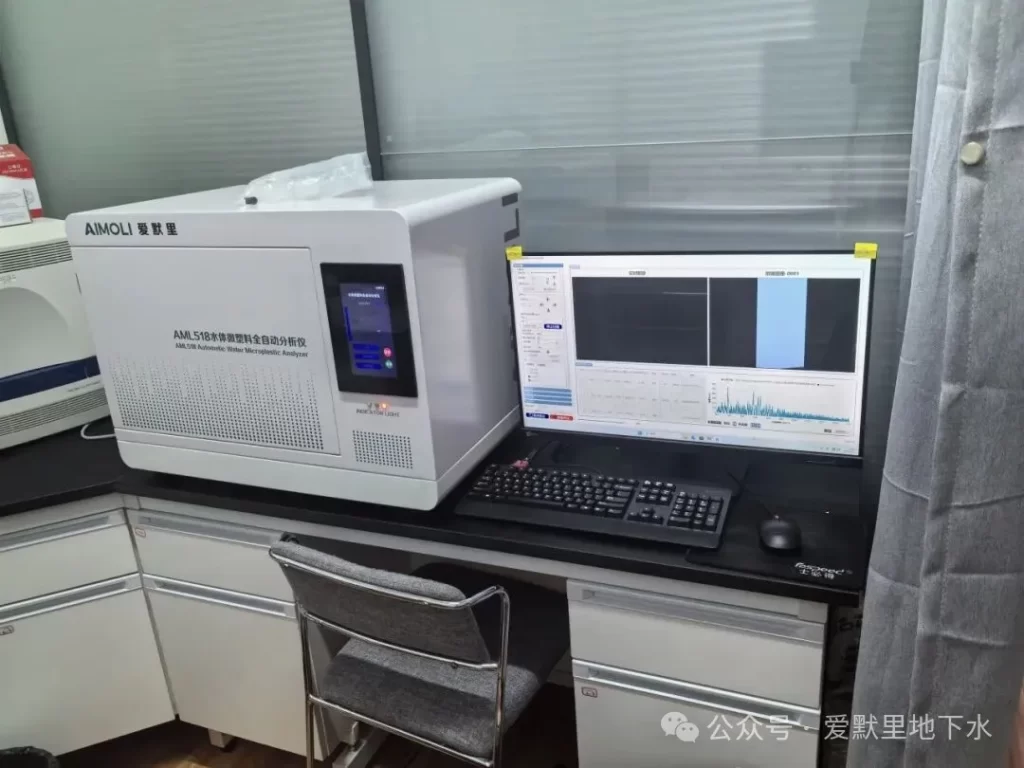
1. Equipment Installation Completed, Training Finished, and Ready for Operation
Last week, we visited a research institute in Beijing to provide on-site operation training for the newly installed AML518 microplastics analyzer. Mr. Liu, who was responsible for coordinating the project, participated throughout the training.
After installation, one of the features that attracted the most attention from the laboratory was direct wet sample testing.
Previously, the laboratory used a microplastics analyzer based on infrared technology. Before testing water samples, they had to dry the samples, transfer the particles, and then prepare sample films. This process was not only time-consuming but also required careful manual operation.
The AML518 adopts microscopic Raman spectroscopy technology and supports direct wet sample testing. It does not require the drying and pressing steps used in traditional infrared sample preparation workflows.
Mr. Liu was particularly satisfied with this feature. After all, their laboratory had been using dry sample pretreatment methods for many years, and the time and labor involved in sample preparation were familiar challenges for the laboratory staff.
For research laboratories that need to process large numbers of water samples every day, reducing unnecessary pretreatment steps can bring very practical benefits.
2. Traditional Dry Sample Preparation Consumes the Time of the Entire Laboratory
Mr. Liu told us that the microplastics analyzer they previously used was an imported brand. Every test required dry sample preparation first, making the entire process relatively complicated.
Where exactly were the difficulties?
After water samples are filtered, microplastic particles remain on the filter membrane, which still contains moisture. To meet the requirements of infrared testing, the filter membrane must first be dried. The particles then need to be transferred and finally prepared into sample films.
Each step requires careful manual operation. Operators must avoid damaging the particles and minimize particle loss during transfer.
Preparing one batch of samples can take more than half a day, while the analyzer has to wait until the sample preparation is completed before testing can begin.
The problems are not limited to time consumption.
1. Filter membrane background signals and external contamination may affect test results
The filter membrane itself may have certain background interference. Fibers from the surrounding air may also fall into the samples during preparation. These factors may lead to artificially high particle counts.
2. Particle loss may occur during transfer
From water sample filtration to the filter membrane, and then to particle transfer and sample preparation, particle loss may occur throughout the process. The smaller the particle size, the more attention should be paid to potential losses during transfer.
3. Dry samples are inconvenient for repeat testing
After samples have been dried and prepared into sample films, if questions arise about the data later and repeat testing or verification is required, the original samples may no longer be recoverable to their previous state.
4. The testing process still requires manual involvement
Dry sample preparation is only the first step. After samples are loaded into the equipment, laboratory personnel still need to monitor the instrument, scan samples one by one, identify spectra, and organize the data.
For many laboratories, researchers may spend an entire afternoon monitoring the equipment, yet the actual number of samples completed remains limited.
Although these problems may seem separate, they all point to the same requirement: how to reduce sample preparation time and improve microplastics testing efficiency while maintaining testing quality.
3. Why Is Microplastics Research Receiving Increasing Attention?
Why is microplastics research receiving increasing attention this year?
In 2024, a research team from Columbia University in the United States published a study in the Proceedings of the National Academy of Sciences, reporting approximately 240,000 microplastic and nanoplastic particles in one liter of bottled water.
These particles have also been detected in human lungs and blood. However, current evidence mainly supports their detection, while causal relationships with disease and exposure thresholds have not yet been established.
As research related to microplastics continues to develop, scientific research institutions are also seeing increasing demand for microplastics testing in water samples. For laboratories, in addition to testing accuracy, sample pretreatment efficiency, particle identification capabilities, and batch testing capacity also need to be considered.
Especially when dealing with large numbers of water samples, if every sample must undergo drying, transfer, and pressing, followed by individual scanning and data organization by laboratory personnel, testing efficiency will be significantly affected.
Research needs to move forward, and the throughput of microplastics analyzers must keep up first.
This is also why, when developing the AML518 fully automatic microplastics analyzer, we focused on wet sample testing and automated batch testing.
4. Why Do Some Microplastics Analyzers Require Dry Samples While Others Can Test Wet Samples?
Whether wet sample testing is possible is directly related to the analytical principle used by the equipment.
Currently, the common vibrational spectroscopy technologies used in microplastics analysis mainly include microscopic infrared spectroscopy and microscopic Raman spectroscopy. These two technologies work differently and have different requirements for sample moisture content.
1. Microscopic Infrared Spectroscopy: Water Absorption Interferes with Detection
Microscopic infrared spectroscopy mainly identifies polymers based on their characteristic infrared absorption features.
However, water itself strongly absorbs infrared light and can interfere with the characteristic spectra of plastic particles, potentially masking some useful signals.
Therefore, equipment using traditional microscopic infrared technology usually requires samples to be dried and dehydrated first.
This is not simply an operating habit. It is related to the analytical principle and the influence of water on infrared spectra.
2. Microscopic Raman Spectroscopy: Relatively Less Interference from Water
Microscopic Raman spectroscopy uses light scattering signals. Compared with infrared detection, water generally has a weaker influence on Raman signals. Therefore, samples on filter membranes can be tested directly even when moisture is still present.
After testing, the particles remain in their original samples, making subsequent verification and further research more convenient.
Of course, wet sample testing does not mean that all samples require no pretreatment at all. The specific process still needs to be determined according to sample properties, filtration methods, and experimental requirements.
3. ISO 16094-2 Recognizes Analytical Methods for Microplastics in Water
Published in 2025, ISO 16094-2, Water Quality — Analysis of Microplastics in Water — Part 2: Vibrational Spectroscopy Methods, lists infrared and Raman spectroscopy as recognized vibrational spectroscopy methods for microplastics analysis in water.
Therefore, wet sample testing is not a shortcut. It is a formal analytical approach based on the principles of Raman spectroscopy.
In my view, microscopic infrared and microscopic Raman spectroscopy are not simply substitutes for each other. Each has its own suitable applications. Laboratories should select the appropriate analytical method according to sample type, research direction, and actual testing requirements.
5. How Does Our AML518 Achieve Wet Sample Testing and Batch Analysis?
Wet sample testing solves the problem of whether samples need to be dried. Automated batch testing solves the problem of whether laboratory personnel need to stay beside the equipment for long periods.
Only when these two aspects are addressed together can the overall testing efficiency of a laboratory be truly improved.
Our AML518 domestically manufactured fully automatic microplastics analyzer mainly combines microscopic Raman spectroscopy, dual-laser technology, and a robotic arm automatic loading system to achieve wet sample testing and automated batch analysis.
1. Microscopic Raman Spectroscopy Allows Wet Samples to Be Loaded Directly
The AML518 adopts microscopic Raman spectroscopy for analysis and can test filter membrane samples containing moisture.
Compared with the traditional infrared dry sample testing workflow, it does not require samples to be dried, particles to be transferred, or sample films to be prepared first. This reduces sample pretreatment steps.
For laboratories that conduct long-term research on microplastics in water, this can save considerable manual operation time and help reduce particle loss during transfer.
2. 785 nm and 1064 nm Dual-Laser Technology Reduces Fluorescence Interference
Although Raman spectroscopy is suitable for wet sample analysis, there is one issue that requires particular attention: fluorescence interference.
Some plastic pigments and additives may produce strong fluorescence signals when exposed to laser irradiation. These signals can mask the characteristic Raman signals of the plastics themselves and affect spectral identification results.
To address this issue, the AML518 is equipped with two lasers: 785 nm and 1064 nm.
The same particle is scanned separately using both lasers. Based on the actual performance of the two spectra, the result with less fluorescence interference and better signal quality is selected for analysis.
The purpose of the dual-laser design is to reduce the impact of fluorescence interference in different samples and obtain more reliable spectral data during wet sample testing.
3. Robotic Arm Integration Enables 100 Samples per Loading
In addition to wet sample testing, automation is another important design feature of the AML518.
The equipment integrates a robotic arm with the testing system to achieve automatic batch sample loading.
Specific capabilities include:
- 100 samples per loading;
- Continuous rolling sample loading;
- 24-hour unattended operation;
- Continuous testing according to experimental requirements.
Laboratory personnel can prepare samples during the day and start the equipment before leaving work, then check the testing reports the following day.
This eliminates the need for someone to remain beside the equipment and operate it sample by sample. It reduces repetitive work and allows researchers to spend more time on experimental design, result analysis, and scientific research.
4. Full Chinese Touchscreen Interface with Three Operating Modes
The AML518 is equipped with a full Chinese touchscreen interface and supports three operating modes: fully automatic, semi-automatic, and manual.
Different laboratory personnel can switch between these modes according to their actual testing requirements and operating habits.
For laboratories without dedicated spectroscopy specialists, the Chinese interface and multiple operating modes can lower the learning curve for daily equipment operation.
Some tasks that previously required specialized personnel to operate the equipment repeatedly can now be handled by undergraduate-level laboratory staff after training.
5. Laboratory-Tested Recovery Rates: 91% at 300 μm and 97% at 1000 μm
Recovery rate is also an important indicator to consider when evaluating a microplastics analyzer.
Simply put, it refers to how many known particles added to a water sample can ultimately be detected by the equipment. The closer the recovery rate is to 100%, the more reference value the particle quantification results generally have under the corresponding experimental conditions.
According to our laboratory test results:
- 300 μm: 91%;
- 1000 μm: 97%.
These figures are based on our laboratory testing.
It should be noted that actual recovery rates may also be affected by sample type, particle size, pretreatment methods, and experimental conditions. For research applications, we recommend conducting verification using actual samples.
6. Technical Specifications of the AML518 Microplastics Analyzer
The following are the standard configuration specifications of the AML518 microplastics analyzer. Actual purchases shall be subject to the technical agreement signed by both parties.
| Item | Specification |
|---|---|
| Analytical Principle | Microscopic Raman spectroscopy with robotic arm integration |
| Laser | 785 / 1064 nm dual-laser system |
| Identification Range | 50–5000 μm |
| Polymer Identification | 21 types |
| Sample Loading | 100 samples per loading, continuous rolling sample loading, 24-hour unattended operation |
| Imaging Speed | Approximately 18 minutes for 1,800 images of a single glass slide |
| Recovery Rate | 91% at 300 μm; 97% at 1000 μm |
| Operation | Full Chinese touchscreen interface; fully automatic / semi-automatic / manual modes available |
From a product design perspective, the main features of the AML518 correspond to different practical needs in laboratory work:
- Dual-laser technology: Uses 785 nm and 1064 nm dual lasers to reduce fluorescence interference.
- Robotic arm automatic loading: Loads 100 samples at a time, supports continuous rolling loading, and enables 24-hour unattended operation.
- Three operating modes: Fully automatic, semi-automatic, and manual modes are available to meet different operating requirements.
- Direct wet sample testing: Uses microscopic Raman spectroscopy to reduce the drying and pressing steps required by traditional infrared dry sample testing.
For scientific research laboratories that need to conduct long-term microplastics testing in water, these functions can provide practical benefits in sample preparation, equipment operation, and labor requirements.
7. An Honest Assessment: What Should Be Noted When Using the AML518?
When introducing our equipment to customers, I have always believed that we should not only explain what the product can do, but also clearly describe its applicable scope and limitations.
1. Dual-Laser Technology Cannot Completely Eliminate Fluorescence Interference
The 785 nm and 1064 nm dual-laser system can reduce fluorescence interference in some samples, but this does not mean that all fluorescence problems can be solved.
For samples with particularly strong fluorescence, manual verification of spectral results is still necessary. This step cannot be completely eliminated.
2. Dark-Colored Particles and Particles Containing Fillers Require Separate Evaluation
Dark-colored particles and particles containing fillers may produce weak Raman signals, making spectral interpretation more difficult.
For these types of samples, we recommend testing actual samples before formal purchasing or conducting batch analysis.
3. Automatic Testing Does Not Mean That Manual Sample Pretreatment Is Completely Unnecessary
The AML518 can perform automatic sample loading and testing, but sample pretreatment still needs to be completed manually.
For example, filtration and digestion processes require manual operation. Whether these procedures are performed properly will directly affect the quality of the final testing data.
4. Product Specifications Need to Be Verified with Actual Samples
The specifications we provide are based on actual measurements under standard configurations and corresponding experimental conditions. Differences may exist between different batches and customized configurations.
Therefore, before purchasing a microplastics analyzer, I would recommend that customers test their actual samples first and then determine whether the equipment meets their research requirements based on the results.
8. Feedback from the On-Site Training at the Research Institute in Beijing
During this visit to the research institute in Beijing, after completing the installation and training for the AML518, we also had an in-depth discussion with Mr. Liu.
Throughout the training, Mr. Liu expressed recognition of both the wet sample testing function and the automated batch testing capabilities.
He specifically mentioned that being able to test wet samples directly was extremely helpful for their experimental research. Previously, they had to spend considerable time drying and pressing samples. Now, many of these steps could be reduced.
At the same time, the equipment also provides automated batch testing, helping the laboratory save considerable time and reduce the workload of researchers.
For us, what customers truly recognize is not simply an individual product specification, but whether the equipment can solve practical problems in their daily laboratory work.
This is also an important direction in which we continue to improve our domestically manufactured microplastics analyzers.
9. Frequently Asked Questions About Microplastics Analyzers (FAQ)
Q1: Can a microplastics analyzer test wet samples directly?
Yes, but it depends on the analytical principle used by the equipment.
Microscopic infrared detection is susceptible to interference from the infrared absorption of water, so samples usually need to be dried first.
Microscopic Raman spectroscopy uses light scattering signals, and water generally has a relatively weak influence on Raman signals. Therefore, filter membrane samples containing moisture can be tested directly.
The AML518 adopts microscopic Raman spectroscopy and supports direct wet sample testing.
Q2: What is the particle identification range of the AML518 microplastics analyzer?
The standard identification range of the AML518 is 50–5000 μm.
If the research involves smaller microplastics or nanoplastics, other suitable analytical technologies need to be selected according to the specific testing requirements.
Q3: Can the AML518 detect nanoplastics?
No.
The lower identification limit of the AML518 is 50 μm, so it is not suitable for nanoplastics detection.
For nanoplastics research, thermal analytical techniques such as pyrolysis-gas chromatography-mass spectrometry can be considered. These methods are mainly used to analyze polymer composition and mass information, and cannot provide the morphology and particle size of individual particles.
Q4: Does the AML518 require all 100 samples loaded at one time to be identical?
No.
The AML518 supports continuous rolling sample loading and scans slides one by one. Samples from different batches and different sources can be arranged together for testing.
Q5: What is the difference between microscopic Raman and microscopic infrared microplastics analyzers?
The main differences lie in their analytical principles and application scenarios.
Microscopic infrared spectroscopy identifies polymers based on their infrared absorption characteristics. Water can easily interfere with the detection signals, so samples usually need to be dried first.
Microscopic Raman spectroscopy uses light scattering signals. Water has a relatively weaker influence on the detection signals, making it more suitable for testing samples containing moisture.
Both technologies have their own advantages and are not complete substitutes for each other. Laboratories can choose between them according to sample types and research requirements, or use them together.
Q6: How long can the AML518 microplastics analyzer operate continuously?
The AML518 supports continuous rolling sample loading with 100 samples per loading and can perform automatic testing unattended for 24 hours.
Laboratory personnel can arrange equipment operation according to sample preparation and testing tasks.
Q7: What is the recovery rate of the AML518 microplastics analyzer?
According to our laboratory test results:
- 300 μm: 91%;
- 1000 μm: 97%.
Actual recovery rates may be affected by sample properties, particle size, pretreatment methods, and experimental conditions. We recommend verification using actual samples.
Q8: What lasers does the AML518 use, and what is the purpose of its dual-laser system?
The AML518 is equipped with 785 nm and 1064 nm dual lasers.
The two lasers scan the same particle separately. Based on the spectral performance, the result with less fluorescence interference and better signal quality is selected, thereby reducing fluorescence interference in some samples.
Q9: Which laboratories are suitable for the AML518 microplastics analyzer?
The AML518 is mainly designed for research and testing laboratories with water-based microplastics analysis requirements.
It is particularly suitable for:
- Research institutions conducting microplastics testing in water;
- Laboratories seeking to reduce the workload of traditional dry sample pretreatment;
- Research teams with batch microplastics testing requirements;
- Laboratories seeking automatic sample loading and 24-hour unattended operation;
- Testing institutions conducting wet sample Raman spectroscopy analysis.
For nanoplastics, samples with strong fluorescence, and particles containing special fillers, the equipment’s suitability needs to be evaluated in advance.
Q10: What specifications should be considered when purchasing a microplastics analyzer?
When selecting a microplastics analyzer, we recommend paying attention to the following aspects:
- Analytical Principle: Whether the equipment uses microscopic infrared or microscopic Raman spectroscopy, and whether it meets the testing requirements of your samples.
- Identification Range: Whether the particle size range covers the requirements of your research.
- Polymer Identification Capability: Which types of polymers the equipment can identify.
- Sample Pretreatment: Whether wet sample testing is supported and whether drying and pressing are required.
- Automation Level: Whether automatic sample loading, batch scanning, and unattended operation are supported.
- Testing Performance: Recovery rate, spectral identification capabilities, and actual sample testing results.
- Operation and Maintenance: Whether the equipment is convenient for daily laboratory use and whether installation training and technical support are provided.
For research laboratories, equipment should not be selected based only on a specification sheet. It is better to conduct testing using actual samples.
About the AML518 Domestically Manufactured Fully Automatic Microplastics Analyzer
We developed the AML518 mainly to help research and testing laboratories address problems such as complicated sample pretreatment, heavy manual workloads, and insufficient batch testing efficiency during microplastics analysis.
Based on the actual application at the research institute in Beijing, direct wet sample testing and automated batch sample loading are two features that the customer particularly appreciated.
If your laboratory also has requirements for microplastics testing in water and is looking for a microplastics analyzer that supports wet sample testing, automatic sample loading, and batch analysis, you can learn more about the AML518’s technical configuration and suitability based on your actual sample types, particle size range, and research direction.
