Function:The AML518 Automated Microplastic Analyzer for Water is a high-precision instrument that integrates microscopy and Raman spectroscopy, specifically designed to identify, analyze, and characterize tiny plastic particles (ranging from the micrometer to millimeter scale) in water.
Advantages:Currently, all similar products worldwide rely on manual operation without exception; AIMOLI is the only company to have developed an automated microplastic analyzer.
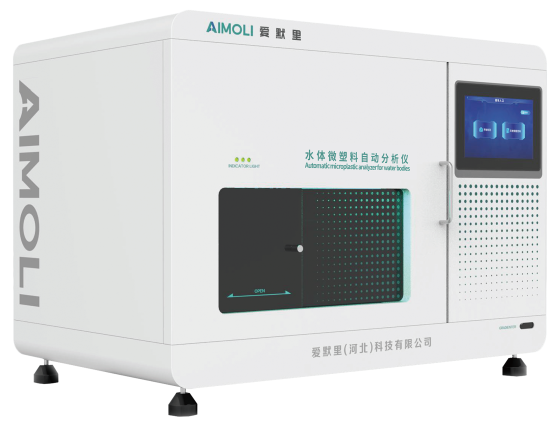
一、The world’s only fully automated system, delivering a 20-fold increase in efficiency
Currently, microplastic detection worldwide remains heavily reliant on manual processes. Traditional laboratory workflows involve multiple steps—such as sample pretreatment, slide preparation, microscopic observation, spectral acquisition, and data comparison—which are time-consuming, labor-intensive, and prone to human error.
The AML518 Microplastic Analyzer for Water is the first to incorporate a robotic arm and an intelligent integrated operation system, enabling automatic sample handling, focusing, scanning, verification, and report generation.
The sample rack accommodates 10–20 microscope slides, and the instrument supports continuous 24-hour operation, boosting efficiency by up to 20 times compared to manual methods.
二、Comparison of Three Technical Approaches: Raman Spectroscopy Emerges as the Winner
There are currently three mainstream technologies for microplastic analysis:
- Infrared Spectroscopy: Struggles to identify particles smaller than 10 µm; requires dry sample preparation (precluding wet analysis) and involves expensive equipment.
- Pyrolysis-Gas Chromatography-Mass Spectrometry (Py-GC-MS): Capable of detecting nanoplastics but entails extremely high costs, making widespread adoption difficult.
- Raman Spectroscopy: Accurately identifies various types of microplastics; supports wet analysis, requires no complex sample pretreatment, and offers excellent cost-effectiveness.
The AML518 ultimately utilizes Raman spectroscopy technology, supporting the identification of microplastics in the 300 µm to 5000 µm (0.3 mm to 5 mm) range. It employs a dual-laser design (785 nm/1064 nm) to effectively mitigate fluorescence interference, achieving an optimal balance between accuracy and cost.
三、Automated workflow enabling unattended operation
The AML518 features a fully optimized workflow:
Flexible operation: Users can choose between fully automated, semi-automated, and manual modes to meet diverse testing requirements.
Pre-treatment: Samples undergo oxidation, digestion, sedimentation, vacuum filtration, and transfer to prepare slides.
Robotic handling: Automated, seamless slide loading and unloading.
Intelligent detection: The microscope automatically focuses and images the sample in a 12-grid layout, creating profiles for each microplastic particle (including coordinates, morphology, and particle size).
Spectral identification: A dual-optical-path design enhances signal sensitivity, followed by automated database matching and classification.
Verification mechanism: Suspected samples undergo automatic recalibration and re-testing to ensure reliable results.
One-click reporting: Automated generation of test reports containing images, data, and classification results.
AML518 Automatic Microplastic Analyzer for Water | Raman Microplastic Detection System
Microplastics in water are difficult to analyze because particles can vary significantly in size, shape and composition. Traditional laboratory workflows often require multiple manual steps, including sample pretreatment, filtration, microscopic observation, spectral acquisition and data analysis.
The AML518 Automatic Microplastic Analyzer for Water is designed to automate these processes.
AML518 integrates microscopy, Raman spectroscopy, robotic sample handling and intelligent analysis software into one system for the identification, analysis and characterization of microplastic particles in water.
According to AIMOLI’s product development information, AML518 is designed to automate the microplastic analysis workflow that is traditionally performed manually.
The system supports microplastic identification in the 300 μm to 5000 μm (0.3 mm to 5 mm) range and uses a dual-laser Raman configuration with 785 nm and 1064 nm wavelengths to reduce fluorescence interference during spectral identification.
What Is the AML518 Automatic Microplastic Analyzer?
The AML518 Automatic Microplastic Analyzer is an automated laboratory instrument for detecting and identifying microplastic particles in water samples.
The system combines:
- Microscopic imaging
- Raman spectroscopy
- Robotic sample handling
- Automatic focusing
- Automatic scanning
- Spectral identification
- Database matching
- Automatic verification
- Automated report generation
Instead of requiring operators to manually perform every stage of observation and identification, AML518 integrates these operations into an automated workflow.
The system is designed for laboratories and organizations that need to analyze microplastics in water efficiently and consistently.
What Can AML518 Analyze?
AML518 is designed to identify and characterize microplastic particles in water samples.
Its analysis process can provide information including:
- Microplastic particle coordinates
- Particle morphology
- Particle size
- Microscopic images
- Raman spectral information
- Material classification
- Analysis results
The system supports microplastic identification from 300 μm to 5000 μm, equivalent to 0.3 mm to 5 mm.
This size range covers many microplastic particles encountered in routine water monitoring and laboratory analysis.
Why Is Automated Microplastic Analysis Needed?
Traditional microplastic analysis often requires several independent laboratory operations.
A typical workflow may involve:
Sample Pretreatment
↓
Digestion / Oxidation
↓
Sedimentation
↓
Vacuum Filtration
↓
Slide Preparation
↓
Microscopic Observation
↓
Particle Selection
↓
Spectral Acquisition
↓
Database Comparison
↓
Result Verification
↓
Report Generation
When these operations are performed manually, the process can require substantial technician time.
Manual operation may also introduce differences between operators, particularly during particle selection, focusing, spectral acquisition and result verification.
AML518 is designed to integrate these operations into a more automated workflow.
AML518 Automated Microplastic Analysis Workflow
The AML518 workflow consists of several interconnected stages.
1. Sample Pretreatment
Water samples undergo the required pretreatment procedures, including:
- Oxidation
- Digestion
- Sedimentation
- Vacuum filtration
- Transfer to microscope slides
The purpose of pretreatment is to prepare the sample for microscopic observation and subsequent Raman identification.
2. Automated Slide Handling
AML518 incorporates a robotic handling system.
The sample rack can accommodate 10–20 microscope slides, allowing multiple samples to be loaded for continuous analysis.
The robotic system automatically handles slide loading and unloading.
3. Automatic Microscopic Observation
After the slide is positioned, the microscope automatically focuses on the sample.
The system scans the sample using a 12-grid layout.
This allows the instrument to systematically examine the prepared sample rather than relying entirely on manual microscope operation.
4. Microplastic Particle Profiling
During microscopic analysis, the system creates a profile for each detected particle.
The profile can include:
- Particle coordinates
- Particle morphology
- Particle size
- Microscopic image information
These data provide the basis for subsequent spectral identification.
5. Raman Spectral Identification
After microscopic detection, the system performs Raman spectral acquisition.
AML518 uses a dual-laser configuration of 785 nm and 1064 nm.
The dual-laser design is intended to help reduce the effects of fluorescence interference during Raman analysis.
The acquired spectrum is then compared with the identification database.
6. Automatic Verification
When a particle produces a suspected or uncertain result, the system can automatically perform recalibration and retesting.
This verification mechanism is designed to improve the reliability of particle identification.
7. Automatic Report Generation
After analysis is completed, AML518 can automatically generate a test report.
The report can contain:
- Particle images
- Analysis data
- Classification results
This eliminates the need to manually compile the primary analysis results into a report.
Three Main Technologies for Microplastic Analysis
Microplastic analysis can be performed using different analytical technologies.
Three commonly discussed approaches are:
- Infrared spectroscopy
- Pyrolysis-GC-MS
- Raman spectroscopy
Each technology has different characteristics and application requirements.
Infrared Spectroscopy for Microplastic Analysis
Infrared spectroscopy is widely used for material identification.
However, according to the technical comparison used in AML518’s development, infrared methods can have difficulty identifying particles below approximately 10 μm.
Another consideration is sample preparation.
Some infrared analysis methods require dry samples, which can limit their suitability for certain wet-sample analysis workflows.
Equipment cost can also be a consideration when selecting an analytical technology.
Pyrolysis-GC-MS for Microplastic Analysis
Pyrolysis-Gas Chromatography-Mass Spectrometry (Py-GC-MS) is another analytical approach for polymer analysis.
One advantage of this method is its ability to analyze very small plastic particles, including nanoplastic-related applications.
However, Py-GC-MS generally involves complex instrumentation and high equipment and operating costs.
This can make it less accessible for laboratories that require routine or large-volume microplastic screening.
Raman Spectroscopy for Microplastic Identification
Raman spectroscopy provides a different approach.
It can identify polymer materials through their characteristic Raman spectra.
For microplastic analysis, Raman spectroscopy offers several important advantages:
- Material identification capability
- Compatibility with small particles
- Ability to analyze different polymer types
- Potential for wet-sample analysis
- Reduced dependence on complex dry-sample preparation
- Good balance between analytical capability and equipment cost
For these reasons, AML518 uses Raman spectroscopy as its primary material-identification technology.
Why AML518 Uses 785 nm and 1064 nm Raman Lasers
Fluorescence interference can be a challenge during Raman analysis.
Certain sample materials can produce strong fluorescence when exposed to a laser wavelength, making Raman spectral signals more difficult to identify.
AML518 therefore uses a dual-laser configuration:
785 nm Laser
Provides Raman excitation suitable for a range of polymer identification applications.
1064 nm Laser
Provides an alternative excitation wavelength that can help reduce fluorescence interference for samples where 785 nm excitation is less suitable.
The dual-laser configuration gives AML518 greater flexibility when analyzing different microplastic samples.
AML518 Microplastic Detection Range
AML518 supports microplastic identification in the following range:
| Parameter | AML518 |
|---|---|
| Minimum particle size | 300 μm |
| Maximum particle size | 5000 μm |
| Equivalent range | 0.3–5 mm |
| Raman laser wavelengths | 785 nm / 1064 nm |
| Sample rack capacity | 10–20 microscope slides |
| Continuous operation | Up to 24 hours |
| Microscopic scanning | 12-grid layout |
| Operation modes | Fully automatic / Semi-automatic / Manual |
These are the core product specifications provided for the AML518 system.
Three Operation Modes
AML518 is not limited to fully automatic operation.
The system provides three operating modes.
Fully Automatic Mode
The instrument performs the integrated analysis workflow with minimal manual intervention.
This mode is suitable for laboratories processing multiple samples or requiring continuous operation.
Semi-Automatic Mode
Operators can intervene at selected stages of the workflow while allowing the instrument to automate other operations.
This provides greater flexibility for laboratories with different testing requirements.
Manual Mode
Manual operation can be selected when users need direct control over specific analysis steps.
This is useful for research, method development, unusual samples or special analytical requirements.
The three modes allow AML518 to adapt to different laboratory workflows instead of forcing every application into a single operating procedure.
Robotic Sample Handling
One of the key differences between AML518 and conventional manually operated microplastic analysis workflows is its integrated robotic handling system.
The sample rack can accommodate 10–20 microscope slides.
The robotic system can automatically:
- Load slides
- Position slides
- Move between samples
- Remove slides
This allows multiple prepared samples to be analyzed sequentially.
The automation is particularly useful for laboratories that need to process a large number of samples without requiring an operator to manually position every slide.
24-Hour Continuous Operation
AML518 supports 24-hour continuous operation.
Combined with automated slide handling, automatic focusing, scanning, spectral identification, verification and reporting, this allows the instrument to operate continuously rather than being limited to the working time of a laboratory technician.
According to AIMOLI’s product information, the automated workflow can increase analysis efficiency by up to 20 times compared with manual methods.
The actual efficiency improvement depends on sample type, sample preparation, particle concentration, analysis parameters and laboratory workflow.
How AML518 Improves Microplastic Analysis Efficiency
The efficiency improvement comes from the integration of multiple automated operations.
Traditional workflow:
Manual Sample Preparation
→
Manual Slide Handling
→
Manual Focusing
→
Manual Observation
→
Manual Particle Selection
→
Manual Spectral Acquisition
→
Manual Data Comparison
→
Manual Verification
→
Manual Report Preparation
AML518 workflow:
Prepared Slides
→
Automatic Slide Handling
→
Automatic Focusing
→
12-Grid Scanning
→
Particle Profiling
→
Automatic Raman Identification
→
Database Matching
→
Automatic Verification
→
Automatic Report Generation
The objective is to reduce repetitive manual work and allow laboratory technicians to focus on sample preparation, quality control and result interpretation.
Automatic Verification of Suspected Results
Automated analysis must also address uncertain identification results.
AML518 includes an automatic verification mechanism.
When a suspected result requires further confirmation, the system can perform:
Automatic Recalibration
↓
Repeated Measurement
↓
Result Verification
This reduces the need for the operator to manually identify every uncertain particle.
The verification process is intended to improve confidence in the final classification results.
Automated Microplastic Analysis Reports
After analysis, AML518 can automatically generate a test report.
The report can contain:
- Microplastic particle images
- Particle data
- Classification results
Automated reporting helps reduce the manual work required after analysis.
It also provides a structured record of the analytical results for laboratory documentation and subsequent review.
AML518 Applications
The AML518 Automatic Microplastic Analyzer can be applied to different types of water-related microplastic research and monitoring.
Potential applications include:
Environmental Water Monitoring
For analyzing microplastic contamination in water bodies.
Laboratory Microplastic Research
For research institutions studying microplastic characteristics and distribution.
Surface Water Analysis
For microplastic analysis in lakes, rivers and other surface-water environments.
Environmental Pollution Investigation
For identifying and characterizing microplastic particles during environmental investigations.
Water Quality Research
For laboratories conducting microplastic-related water-quality studies.
Long-Term Microplastic Monitoring
For repeated analysis of water samples collected during environmental monitoring programs.
The appropriate sample preparation and analytical procedure should be selected according to the specific sample type and research objective.
AML518 vs. Traditional Manual Microplastic Analysis
| Feature | Traditional Manual Workflow | AML518 |
|---|---|---|
| Slide handling | Manual | Robotic |
| Focusing | Manual | Automatic |
| Microscopic scanning | Manual | Automatic |
| Particle profiling | Manual | Automatic |
| Raman identification | Operator-controlled | Automated |
| Database matching | Manual/assisted | Automatic |
| Suspected-result verification | Manual | Automatic recalibration and retesting |
| Report generation | Manual | One-click automated generation |
| Operation modes | Mainly manual | Automatic / Semi-automatic / Manual |
| Slide capacity | Operator dependent | 10–20 slides |
| Continuous operation | Limited by operator | Up to 24 hours |
| Efficiency | Traditional baseline | Up to 20× according to AIMOLI’s product information |
Why Choose the AML518 Automatic Microplastic Analyzer?
AML518 is designed around a different concept from conventional microplastic analysis equipment.
Instead of automating only one part of the analysis, it integrates multiple laboratory operations into a single workflow.
Its key capabilities include:
Automated Sample Handling
Robotic handling of prepared microscope slides.
Automated Microscopy
Automatic focusing and 12-grid sample scanning.
Particle Characterization
Automatic recording of particle coordinates, morphology and size.
Raman Identification
Dual-laser Raman spectroscopy using 785 nm and 1064 nm wavelengths.
Automatic Database Matching
Automated comparison of Raman spectra with the identification database.
Automatic Verification
Recalibration and retesting of suspected results.
Automatic Reporting
One-click generation of reports containing images, data and classification results.
This integrated approach is the core technical value of AML518.
AML518 Technical Specifications and Core Functions
| Category | AML518 |
|---|---|
| Product | Automatic Microplastic Analyzer for Water |
| Main analytical technologies | Microscopy + Raman spectroscopy |
| Microplastic detection range | 300–5000 μm |
| Equivalent particle size range | 0.3–5 mm |
| Raman lasers | 785 nm + 1064 nm |
| Sample rack capacity | 10–20 microscope slides |
| Continuous operation | 24 hours |
| Microscopic scanning | 12-grid layout |
| Operation modes | Fully automatic / Semi-automatic / Manual |
| Sample handling | Robotic automatic handling |
| Particle information | Coordinates, morphology, particle size |
| Spectral identification | Automatic Raman acquisition and database matching |
| Verification | Automatic recalibration and retesting |
| Reporting | Automated report generation |
Frequently Asked Questions About AML518
What is the AML518 Automatic Microplastic Analyzer?
AML518 is an automated instrument designed to identify and characterize microplastic particles in water by combining microscopy, Raman spectroscopy, robotic sample handling and automated data analysis.
What size of microplastics can AML518 detect?
AML518 supports microplastic identification in the 300 μm to 5000 μm range, equivalent to 0.3 mm to 5 mm.
What Raman wavelengths does AML518 use?
AML518 uses a dual-laser Raman configuration with 785 nm and 1064 nm wavelengths.
Why does AML518 use two Raman lasers?
The dual-laser design provides different excitation options and helps address fluorescence interference that can affect Raman spectral identification.
How many microscope slides can AML518 hold?
The sample rack can accommodate 10–20 microscope slides.
Can AML518 operate continuously?
Yes. AML518 supports 24-hour continuous operation.
Does AML518 require manual operation?
AML518 supports three operating modes: fully automatic, semi-automatic and manual.
How does AML518 identify microplastic particles?
The system first uses microscopy to detect and characterize particles. It then obtains Raman spectral information and compares the results with its identification database for material classification.
Can AML518 automatically verify uncertain results?
Yes. Suspected results can undergo automatic recalibration and retesting as part of the verification process.
Can AML518 automatically generate reports?
Yes. The system can generate reports containing images, analysis data and classification results.
