Recently, I led the technical team of AIMOLI (Hebei) Technology Co., Ltd. to a university in Jiangsu to carry out on-site installation, operation training, and project acceptance of the AML518 Fully Automatic Microplastics Analyzer.
This customer acceptance was not only an equipment delivery but also an opportunity for face-to-face technical communication. Through on-site demonstrations and hands-on operation, we hoped to help the teachers and students truly understand the equipment’s functions, become familiar with its operating procedures, and independently perform routine testing.
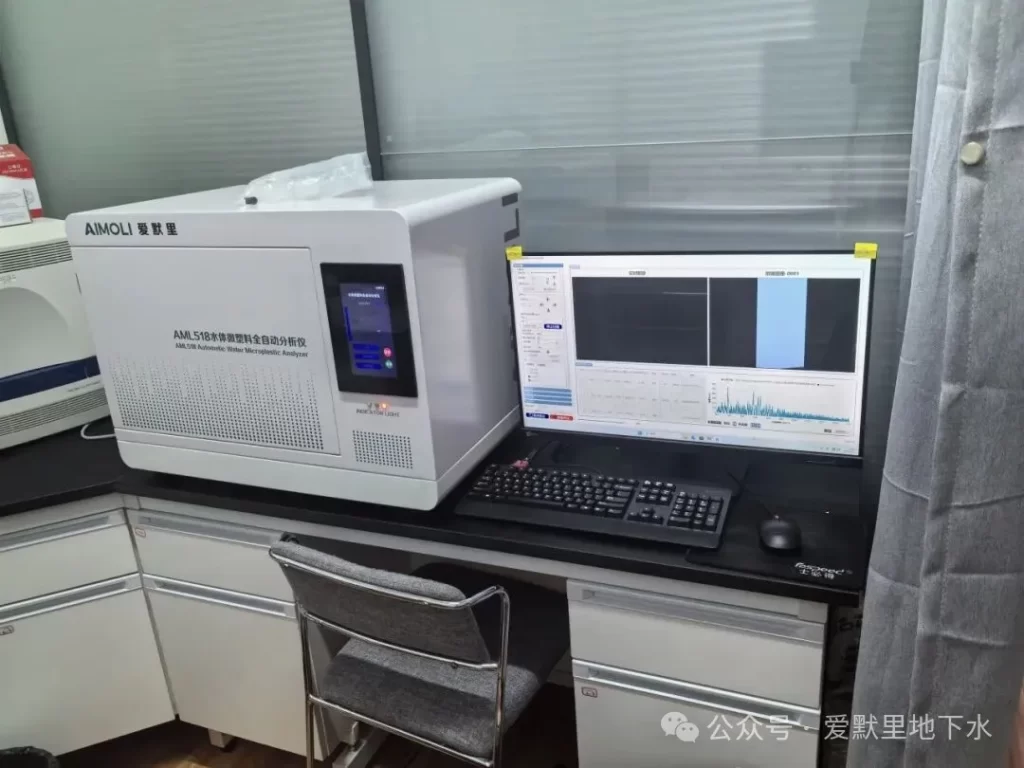
1. Arriving at the Customer’s Site and Carrying Out Equipment Installation and Commissioning
After arriving at the customer’s site, our technical personnel first assembled, connected, and performed basic checks on the equipment.
The AML518 Fully Automatic Microplastics Analyzer features an integrated design. The main unit was placed on the laboratory bench, followed by connections to the supporting computer tower, monitor, keyboard, and mouse. The accompanying operating software was also installed and checked to ensure proper operation.
After installation, our technical personnel checked the basic functions of the equipment to prepare for the subsequent on-site training and actual testing.
2. Understanding Customer Requirements and Confirming Training and Acceptance Arrangements
A total of five people participated in this on-site training, including one instructor and four students, covering both undergraduate and postgraduate students.
Before the formal training began, we communicated with the instructor to gain a better understanding of the laboratory’s current microplastics testing requirements.
According to our discussion, the university mainly works with soil samples, while water sample testing is relatively less frequent. Previously, related microplastics testing work had mainly been outsourced to third-party testing institutions.
Although this approach could meet some testing requirements, it presented two relatively obvious problems:
First, testing costs were relatively high. Long-term reliance on third-party testing services resulted in ongoing testing expenses and increased the costs of research projects.
Second, testing cycles were relatively long. Samples needed to be submitted, queued for testing, and processed before results could be obtained, making it difficult to coordinate testing schedules flexibly with research progress.
Therefore, the laboratory hoped to improve its independent testing capabilities by purchasing professional microplastics analysis equipment and reduce its reliance on outsourced testing services.
3. What Are the Problems with Traditional Microplastics Testing Methods?
During our discussion, we also introduced the traditional methods used for microplastics testing.
Traditional microplastics testing generally relies on manual microscopic observation and analysis. Technicians need to manually select suspected microplastic particles one by one and place them on microscope slides or filter membranes before carrying out manual observation, comparison, and analysis using analytical instruments.
During the testing process, information such as particle size, color, type, and abundance needs to be analyzed. This involves extensive manual operations, data recording, and statistical calculations before a complete testing report can be generated.
This method not only requires a certain level of experience from operators but also has relatively low testing efficiency.
Taking traditional water sample testing as an example, the overall testing cycle for a single sample may take 10–20 days and, in some cases, nearly one month. A single water sample may also require the preparation of 10–20 microscope slides, further increasing the workload involved in sample preparation and manual testing.
For laboratories conducting long-term microplastics research, traditional testing methods have certain limitations in terms of efficiency and automation.
4. On-Site Operation Training for the AML518 Fully Automatic Microplastics Analyzer
After understanding the customer’s actual requirements, our technical personnel provided a systematic explanation of the AML518 Fully Automatic Microplastics Analyzer, covering its structure, operating procedures, operating modes, and testing reports.
The AML518 can be used for microplastics analysis in water samples, soil samples, and other types of samples. After undergoing the corresponding routine pretreatment, samples can be prepared on microscope slides for testing.
The equipment’s sample stage can accommodate up to 10 microscope slides at a time. After loading the sample slides onto the stage and placing it inside the analyzer, users can select the appropriate operating mode according to their testing requirements.
The equipment supports two operating modes:
- Fully Automatic Mode: The equipment automatically completes sample pickup, sample transfer, scanning, focusing, image acquisition, and other procedures according to the preset workflow.
- Manual Mode: Users perform the corresponding operations according to their actual testing requirements. This mode is suitable for testing scenarios that require manual involvement.
1. Fully Automatic Testing Process
In Fully Automatic Mode, operators only need to register basic information such as sample names and sample numbers according to the software instructions. After completing the parameter settings, they can click Start, and the equipment will automatically perform the subsequent testing procedures.
From sample pickup and automatic sample transfer to scanning, focusing, and image acquisition, the entire process is completed automatically by the equipment without requiring operators to repeatedly make manual adjustments.
For a single microscope slide, the equipment takes only a little over ten minutes to capture 1,800 images, significantly reducing the workload associated with manual observation and photography.
2. AI-Powered Intelligent Identification and Automatic Analysis
After image acquisition is completed, the AML518 can further perform particle identification, screening, and AI-based spectral data acquisition and analysis.
The system can obtain information such as particle aspect ratio, area, equivalent diameter, and color. Combined with spectral analysis results, it can match the similarity of suspected microplastic particles and determine their types.
After testing is completed, the software can automatically organize the relevant data, generate testing reports, and provide corresponding spectral analysis results.
From image acquisition and particle identification to data analysis and report generation, multiple testing procedures are seamlessly integrated through automation.
At the same time, the equipment supports 24-hour unattended automatic testing. Under appropriate operating conditions, it can reduce the need for manual supervision and improve laboratory testing efficiency.
5. Teachers and Students Independently Complete Operations and Proceed to Project Acceptance
After the equipment introduction and operation training were completed, we did not stop at simply demonstrating its functions. Instead, we arranged for the teachers and students to operate the equipment themselves.
Under the on-site guidance of our technical personnel, the instructor and four students gradually became familiar with the software interface and equipment operating procedures. They independently completed parameter settings, sample placement, test initiation, data analysis, and testing report generation.
Afterward, everyone also reviewed and discussed the relevant data and analytical results in the testing reports.
Through hands-on operation, the teachers and students gained a more intuitive understanding of the equipment’s operating methods, automated testing workflow, and report analysis functions. They also basically mastered the equipment’s routine operating procedures.
6. Customer Acceptance Completed and On-Site Recognition Received
After the training and hands-on operation were completed, we worked together with the customer to confirm the equipment’s operating status, training results, and relevant delivery documents.
Based on the feedback received on-site, the customer was quite satisfied with the overall user experience of the AML518 Fully Automatic Microplastics Analyzer.
The instructor commented that the domestic instrument offered a good user experience and relatively simple operating procedures, and could meet the laboratory’s requirements for related testing work.
In addition, the accompanying simplified operation guide also received positive feedback from the customer. The operating procedures are clearly presented, and the manual is designed to suit the usage habits of domestic users, making it convenient for teachers and students to consult whenever necessary during subsequent operation.
Finally, the customer filled in a satisfactory evaluation on the equipment training and acceptance form and affixed the university’s official seal, expressing recognition of the equipment delivery, training, and acceptance work.
With this, the on-site installation, operation training, and project acceptance of the AML518 Fully Automatic Microplastics Analyzer were successfully completed.
As the founder of AIMOLI, I have always believed that equipment delivery is not simply about delivering an instrument to a customer’s laboratory. More importantly, it is about ensuring that customers truly understand the equipment, master its operating procedures, and are able to apply it to their actual research work.
From initial communication about customer requirements to on-site installation and commissioning, followed by operation training and final acceptance, we hope to handle every step with care and responsibility.
We sincerely thank the teachers at this university in Jiangsu for their trust and recognition of AIMOLI.
Moving forward, AIMOLI will continue to provide professional equipment delivery and technical services, offering reliable instruments and supporting services to more universities and research institutions.
If your university, research institution, or laboratory is conducting microplastics-related research and has purchasing or technical consultation needs for automated microplastics testing equipment, please feel free to contact AIMOLI.
