AIMOLI AML918T Supports Efficient Sampling from Wells Over 150 Meters Deep
For professionals involved in field groundwater monitoring, the real challenge is often not laboratory water analysis, but completing groundwater sampling in the field.
This is especially true in remote mountainous areas, where vehicles cannot reach monitoring sites directly and equipment must be carried manually. When monitoring wells are particularly deep, ordinary sampling pumps may also fail to meet the required pumping lift. Any problem with road conditions, well depth, or equipment configuration can affect the entire sampling schedule.
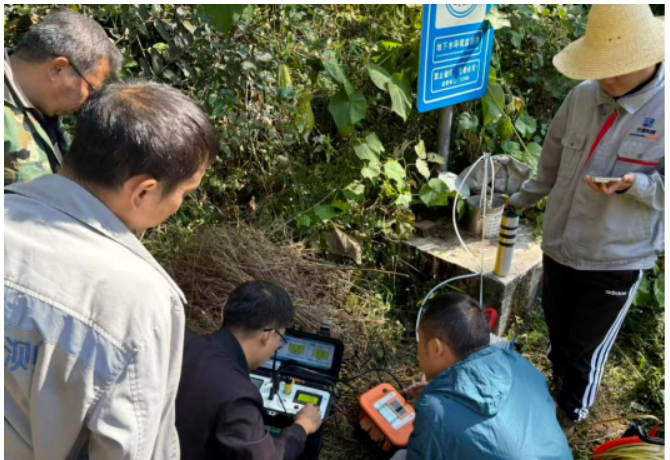
Some time ago, AIMOLI (Hebei) Technology Co., Ltd. worked with a local monitoring center in Dali, Yunnan, on a mountainous groundwater sampling project. All monitoring points were located in mountainous areas with inconvenient transportation, and the monitoring wells were more than 150 meters deep. This placed higher demands on equipment portability, pumping lift, and sampling efficiency.
1. Difficult Mountain Roads Made Equipment Transportation the First Challenge
The monitoring points in this project were scattered across the mountains of Dali, where there were no paved access roads. Vehicles could only be parked at the foot of the mountains, and the remaining distance had to be covered on foot.
The mountain trails had steep slopes and many loose rocks. Some sections were also narrow and slippery. Large equipment could not be transported directly to the wells, so all sampling equipment and accessories had to be carried on the backs or shoulders of the field personnel.
For the monitoring team, this not only increased physical workload but also made equipment size, weight, and ease of assembly particularly important.
If the equipment was too heavy or required too many separate accessories, it would create considerable difficulties during actual field operations, even if its technical specifications met the requirements.
2. Monitoring Wells Deeper Than 150 Meters Required Higher Pumping Lift and Flow Rate
In addition to transportation difficulties, well depth was another major challenge in this project.
All monitoring wells in the project area were deeper than 150 meters, making this a typical deep-well groundwater sampling application.
For wells of this depth, the sampling pump must first provide sufficient pumping lift. Otherwise, it cannot reliably pump groundwater from deep underground to the surface.
At the same time, the monitoring center hoped that the equipment could provide a higher sampling flow rate while maintaining portability and meeting the 150-meter pumping lift requirement. This would help shorten well-purging time and improve overall sampling efficiency while complying with the relevant monitoring standards.
Therefore, we needed to consider not only whether the pump could lift water to the surface, but also its weight, water discharge stability, and flow control capability.
3. Developing a Complete Groundwater Sampling Solution Based on Actual Site Conditions
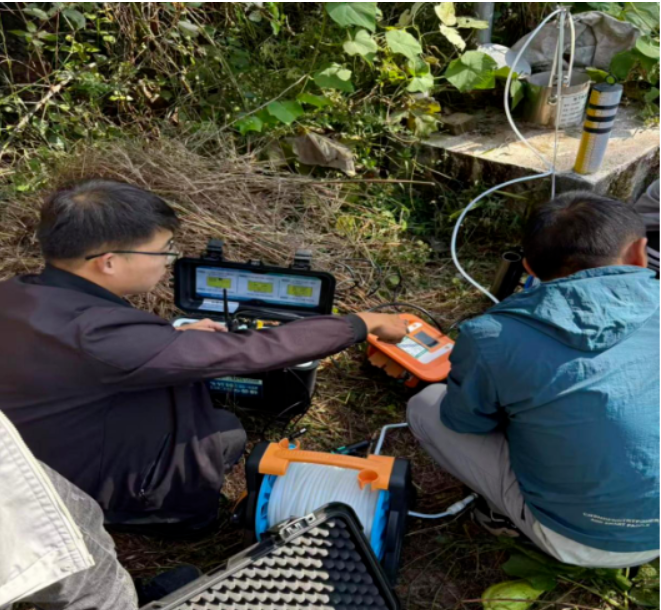
After understanding the project requirements, our technical team developed a coordinated groundwater sampling solution based on the mountainous transportation conditions, monitoring well depths, and actual field sampling requirements.
The main equipment used in this project included:
- AML918T Groundwater Sampling Pump (150-meter pumping lift version)
- Flow meter
- AML913 Groundwater Three-Water-Level Meter
- AML916 Multiparameter Measuring Instrument
This solution combined groundwater level measurement, pumping and well purging, and on-site water quality testing. Our aim was to reduce repeated equipment transportation and simplify field operations as much as possible.
1. AML918T Groundwater Sampling Pump: Meeting the Requirements of Deep-Well Sampling at 150 Meters
The AML918T Groundwater Sampling Pump (150-meter pumping lift version) selected for this project was capable of meeting the well depth requirements.
During actual operation, the pump delivered a stable water output after being lowered into the well, meeting the requirements for deep-well pumping and well-purging operations.
Considering that the monitoring points were located in mountainous areas, we also paid special attention to equipment portability. The AML918T features a lightweight design and can be disassembled into smaller parts for transportation by two workers. No large transportation equipment is required, making it more suitable for mountainous locations that can only be reached on foot.
In addition, when used with an external flow meter, the system allows workers to monitor the water flow rate in real time and adjust the pumping speed according to on-site requirements. This reduces the need to repeatedly start and stop the pump based on personal experience, making the well-purging process more visible and controllable.
For more information about the product, please see AML918 Groundwater sampling pump (0 pollution submersible pump).
2. AML913 Groundwater Three-Water-Level Meter: Understanding Water Level Changes Before Sampling
Before starting the formal pumping and sampling process, we first used the AML913 Groundwater Three-Water-Level Meter to measure the water level inside the monitoring wells.
By measuring the static water level, dynamic water level, and other relevant data, field personnel could understand the basic water level conditions and changes in advance. This provided useful information for subsequent pump deployment and pumping operations, helping reduce operational risks caused by water level fluctuations.
For more product details, please see AML 913 Groundwater three-level meter(Water Level Meter,Well Depth Meter,Drawdown Meter).
3. AML916 Multiparameter Measuring Instrument: On-Site Water Quality Testing
After well purging was completed, we used the AML916 Multiparameter Measuring Instrument for on-site water quality testing.
The instrument can directly measure important water quality parameters, including pH, electrical conductivity, and dissolved oxygen, helping field personnel understand water quality conditions in a timely manner.
If any abnormal results are detected, the team can immediately conduct additional checks on-site. This reduces the time spent transporting samples and waiting for laboratory testing, allowing sampling personnel to make timely decisions about whether further action is required.
For more information, please see AML916 Groundwater six-parameter measuring instrument.
4. Coordinated Equipment Operation Makes Mountainous Groundwater Sampling More Efficient
In this project, we did not simply combine several instruments. Instead, we arranged their use according to the actual field operation process.
First, we used the AML913 Groundwater Three-Water-Level Meter to measure the water level and understand the basic well conditions.
Next, we used the AML918T Groundwater Sampling Pump for pumping and well purging, while monitoring and controlling the water flow rate in real time with the flow meter.
After well purging was completed, we used the AML916 Multiparameter Measuring Instrument to conduct on-site water quality testing.
From water level measurement and pumping to water quality testing, each step had a clear purpose and sequence. This reduced the inconvenience of repeatedly changing equipment and simplified field operations.
For monitoring personnel who had to carry equipment into the mountains on foot, this configuration also reduced the transportation burden associated with carrying multiple independent instruments, making fieldwork more organized and efficient.
5. Choosing Equipment Based on Actual Working Conditions Is More Important Than Simply Comparing Specifications
This groundwater sampling project in the mountainous area of Dali once again reminded us that groundwater monitoring equipment should not be selected based on product specifications alone.
Even when performing the same groundwater sampling task, operating conditions in flat areas can be very different from those in remote mountainous regions. Shallow wells and wells deeper than 150 meters also have significantly different requirements for sampling pumps.
Some projects place greater importance on pumping lift, while others focus more on sampling flow rate. For field operations in mountainous areas, equipment weight, transportation methods, and ease of operation are equally important.
In our view, a groundwater sampling solution that truly meets customer needs must take into account the monitoring site location, well depth, sampling requirements, and actual working conditions of field personnel. It is not simply a matter of putting different instruments together.
Through this project, we also gained more practical experience in groundwater sampling from deep wells in mountainous areas.
In the future, AIMOLI will continue to improve equipment configurations and sampling solutions for deep wells, remote mountainous areas, and other groundwater monitoring sites with difficult transportation conditions. Our goal is to reduce the workload of field monitoring personnel and make groundwater sampling more convenient and efficient.
If you also face challenges involving groundwater sampling in mountainous areas, groundwater sampling from wells deeper than 150 meters, or monitoring projects that require both equipment portability and sampling efficiency, please feel free to contact AIMOLI.
We can recommend suitable groundwater sampling equipment and supporting solutions based on your well depth, site conditions, and sampling requirements.
For a broader overview of our equipment and solutions, please visit Groundwater Sampling Equipment | Pumps, Samplers & Systems.
