On November 25, 2025, I was invited to participate in the School of Environmental Science’s 10th Anniversary Distinguished Lecture Series. Under the theme “New Technologies for Groundwater Sampling and Monitoring,” I shared AIMOLI (Hebei) Technology Co., Ltd.’s technological research and development achievements and practical application experience in the field of groundwater monitoring over the years with faculty members, students, researchers, and industry professionals.
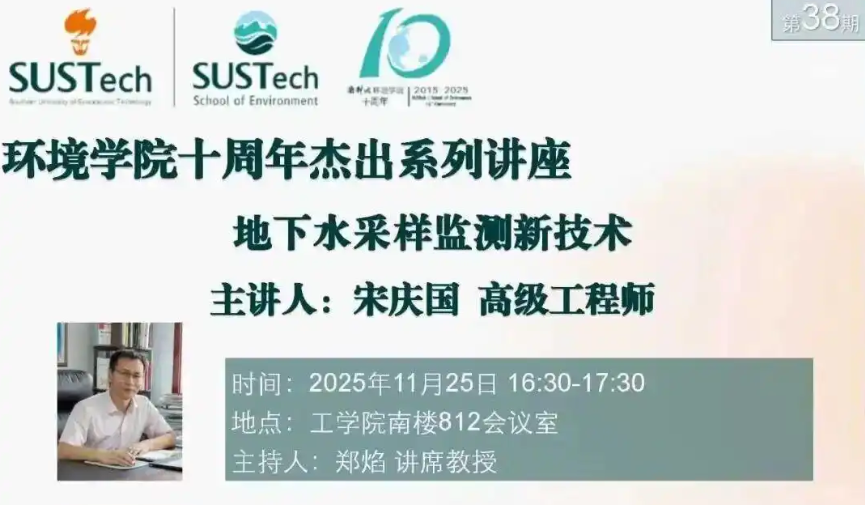
First of all, I would like to sincerely thank the School of Environmental Science for recognizing AIMOLI’s contributions to groundwater monitoring over the years, as well as for providing this valuable opportunity for communication and exchange. I feel very honored to have the opportunity to visit the campus, meet and communicate face-to-face with professors, students, and industry experts, and share some of our practical experience in groundwater monitoring.
This lecture mainly focused on the development of groundwater environmental monitoring technologies and the actual needs of the industry. Drawing on my many years of industry experience, I began with the key technologies involved in groundwater monitoring and also discussed some common problems currently faced by the industry.
In practical work, I have found that the groundwater monitoring field has long faced several prominent challenges. First, some imported equipment is relatively expensive, increasing purchasing costs for users. Second, after-sales service for equipment is not always timely enough, affecting the smooth progress of on-site work. Third, traditional sampling and data collection methods are not sufficiently efficient to meet increasingly refined monitoring requirements.
These challenges have also been among the key issues that AIMOLI has focused on and worked to address since its establishment. In my view, the key to truly changing this situation is to remain committed to independent research and development, master core technologies ourselves, and provide users with more practical, reliable, and cost-effective products through technological innovation.
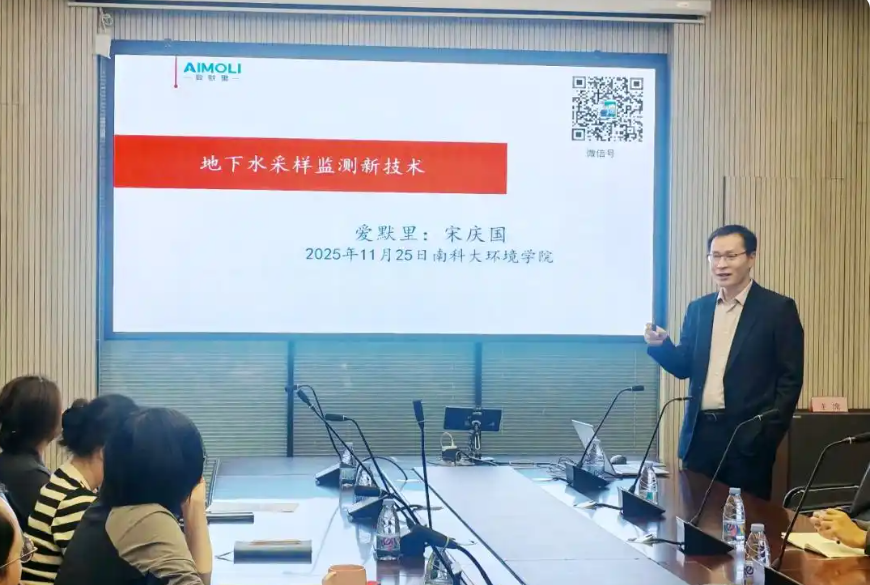
During the lecture, I focused on introducing AIMOLI’s four core technologies in the field of groundwater monitoring:
- Deep-Water Sensor Technology: Designed to meet the needs of deep groundwater monitoring, providing technical support for monitoring water environments at different depths.
- Digital and Intelligent Groundwater Sampling Technology: Through technological innovation, improving the automation and intelligence of groundwater sampling, making on-site sampling more efficient and standardized.
- Groundwater Dynamic Field Monitoring Technology: Providing data support for groundwater environmental investigations and analysis through the monitoring of groundwater movement and related parameters.
- Automated Microplastic Analysis Technology for Water Bodies: Exploring more automated analytical technologies and solutions to meet the needs of microplastic detection in water bodies.
Alongside these four technologies, I also introduced the related equipment independently developed by AIMOLI and explained how these devices are being used in actual projects.
The AML135 Automatic Online Groundwater Monitoring System enables real-time, high-precision data collection around the clock, overcoming the limitations of manual sampling and laboratory testing while providing strong data support for regulatory authorities.
The AML919 Portable Groundwater Sampling System features a lightweight and efficient design, addressing the labor-intensive, physically demanding, and time-consuming challenges of field sampling.
The AML920 Groundwater Flow Velocity and Direction Meter delivers accurate performance and provides reliable data for groundwater dynamics research.
The AML518 Automatic Microplastic Analyzer for Water Bodies enables fully automated detection 24 hours a day, offering significant cost-effectiveness advantages.
To help everyone better understand the practical value of these technologies, I shared several real-world application cases, including groundwater pollution monitoring in large chemical industrial parks, environmental quality investigations at landfill sites, and groundwater safety assessments in drinking water source areas.
In these projects, AIMOLI’s independently developed equipment has gained customer recognition through its stable operating performance, accurate data collection capabilities, and high cost-effectiveness. These practical applications have further strengthened our determination to continue pursuing independent research and development.
For me, this lecture was not only an opportunity to share our technological achievements but also a valuable opportunity for learning and communication. Groundwater environmental monitoring involves multiple professional fields. The development of the industry depends not only on technological innovation but also on mutual cooperation among universities, research institutions, and enterprises.
Looking ahead, AIMOLI will continue to focus on the research and development of groundwater monitoring technologies, continuously improve our products and solutions, and work hard to address the challenges users encounter in their actual work. We aim to provide greater technical support for groundwater environmental monitoring, water environment management, and ecological protection.
At the same time, I sincerely look forward to more opportunities for communication and cooperation with the School of Environmental Science in the future, strengthening our connections in technological research and development, the commercialization of research achievements, and talent cultivation. I hope that by combining the respective strengths of universities and enterprises, we can jointly promote advances in groundwater environmental monitoring technologies and contribute to environmental and ecological protection.
