When a borewell, groundwater well, or monitoring well develops an internal problem, visual inspection is often the fastest way to understand what is happening below the surface. A waterproof borewell camera allows engineers, well contractors, groundwater professionals, and environmental investigators to see conditions inside a borewell without dismantling the entire well structure.
A professional waterproof camera for borewell applications is designed to operate in a submerged underground environment where ordinary inspection cameras cannot work reliably. The camera probe must withstand water exposure, provide sufficient illumination, transmit images to the surface, and deliver useful visual information from inside a narrow and potentially deep borewell.
For buyers researching waterproof camera for borewell price, however, the purchase decision should not be based on price alone. Probe diameter, inspection depth, camera configuration, image quality, cable length, lighting, data recording, monitoring functions, and project requirements can all influence the final equipment configuration and cost.
For groundwater monitoring and environmental inspection projects, AIMOLI offers the AML921 Digital Downhole Camera, a compact digital borehole inspection system developed for groundwater monitoring well inspection and underground visual assessment. According to AIMOLI’s product information, AML921 uses a three-camera digital observation configuration, high-definition imaging, approximately 45 mm probe diameter, and digital storage and transmission of inspection information.
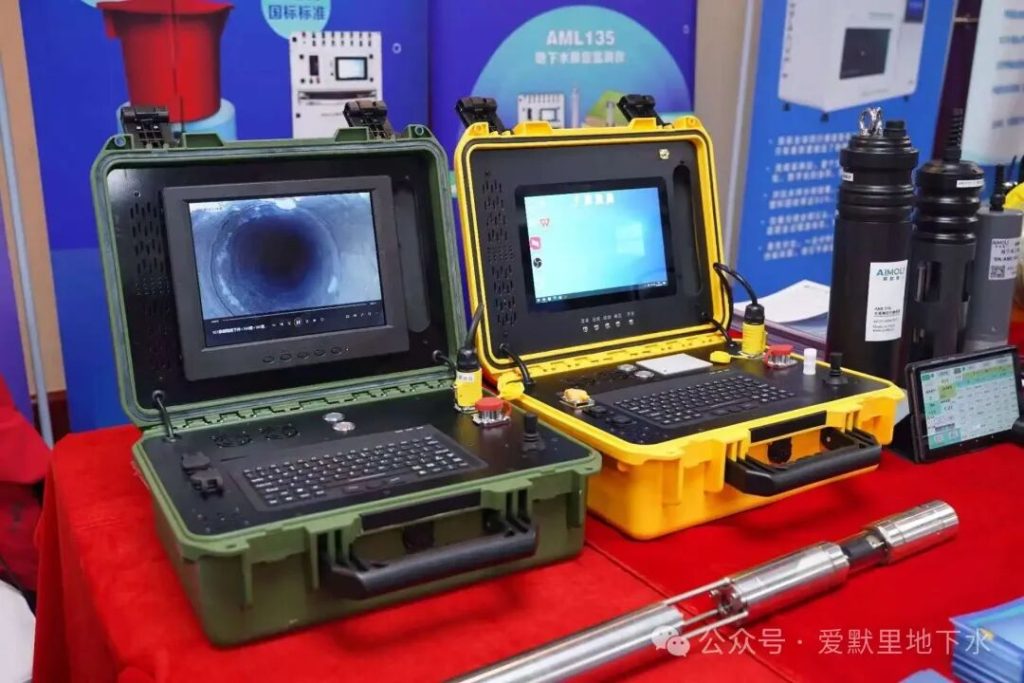
What Is a Waterproof Borewell Camera?
A waterproof borewell camera is a specialized inspection camera designed to operate inside a borewell, water well, monitoring well, or other underground structure where water is present.
Unlike a conventional inspection camera intended for dry pipes or industrial equipment, a professional borewell camera must be engineered for underwater or wet underground operation. The camera probe is lowered into the borewell using a cable or deployment system. The camera captures images inside the well and sends the visual information to surface equipment for real-time viewing, recording, or later analysis.
The U.S. Environmental Protection Agency explains that borehole video logging provides direct visual information about the interior walls of air- or water-filled boreholes, wells, casings, pipes, and tunnels. It can be used to examine well construction, borehole conditions, fractures, cavities, water levels, casing damage, screen conditions, and foreign objects.
This makes a waterproof borewell camera much more than a simple underwater camera. It is an inspection instrument designed around the specific challenges of underground wells.
Why Is a Waterproof Camera for Borewell Inspection Important?
A borewell can look normal from the surface while developing serious internal problems.
The casing may crack. A screen may become clogged. Sediment may accumulate. Foreign objects may fall into the well. Corrosion may affect metal components. Fractures may develop in an open borehole. Changes in groundwater conditions may also affect what engineers observe inside the well.
Without visual inspection, many of these conditions can remain difficult to identify.
A waterproof camera for borewell provides direct visual evidence from inside the well.
Instead of relying only on indirect measurements or assumptions, engineers can lower a camera into the borewell and observe the actual underground environment.
USGS describes borehole camera surveys as useful for understanding conditions such as screen fouling and leaking casing joints. USGS also uses cameras to inspect changes inside groundwater wells that could affect groundwater-level measurements and well integrity.
This is why a professional waterproof borewell camera can be useful before maintenance, after construction, during troubleshooting, or as part of periodic well inspection.
What Can a Waterproof Borewell Camera Detect?
The exact inspection capability depends on the camera system, well construction, water clarity, lighting, depth, and operator experience. However, borehole video inspection can provide important information about the physical condition of a well.
1. Casing Damage
A waterproof camera for borewell can help identify visible cracks, holes, deformation, corrosion, damaged joints, and other abnormalities in accessible casing sections.
Casing condition is important because damaged casing can affect the integrity and performance of a well.
2. Screen Condition
Well screens are particularly important in groundwater wells. Sediment, mineral deposits, biofilm, or other material may affect screen openings.
USGS and EPA materials identify well-screen inspection as an important application of borehole video technology.
A waterproof borewell camera provides a direct visual reference for evaluating visible screen conditions.
3. Sediment and Obstructions
Sediment accumulation or foreign objects may restrict access through part of a borewell.
A camera can help determine whether an obstruction exists and where further investigation may be necessary.
4. Fractures and Open-Borehole Features
In suitable open boreholes, a camera may provide visual information about fractures, cavities, voids, rock textures, and geological features.
The USGS notes that television cameras are commonly used in groundwater studies to inspect casing and screens and to view features such as lithologic texture, water levels, cascading water, and bedrock fractures.
5. Construction Conditions
A waterproof camera for borewell can also be used to verify visible aspects of well construction.
This can be especially valuable when original construction records are incomplete or when engineers need to compare the current condition with historical information.
6. Foreign Objects
Dropped tools, components, cables, debris, or other objects may become trapped inside wells.
Borehole video can help locate and visually assess such objects before retrieval work is attempted.
EPA documentation specifically identifies foreign objects and obstructions as conditions that down-hole well cameras can help identify.
Waterproof Borewell Camera vs. Ordinary Inspection Camera
Not every waterproof camera is suitable for borewell inspection.
A consumer underwater camera may be waterproof, but that does not automatically make it appropriate for professional borewell work.
A professional waterproof borewell camera needs to address several requirements simultaneously:
- Small probe diameter
- Reliable underwater operation
- Appropriate illumination
- Sufficient image quality
- Stable cable deployment
- Adequate inspection depth
- Surface monitoring
- Digital image recording
- Data management
- Compatibility with the well diameter
- Reliable operation during repeated inspections
The deeper and more technically demanding the inspection, the more important the complete system becomes.
EPA describes a borehole video system as including a down-hole video camera and light source, cable, winch, surface control equipment, monitor, recording equipment, and power supply.
Therefore, when comparing waterproof camera for borewell price, buyers should compare the complete inspection system rather than looking only at the camera head.
How Does a Waterproof Camera for Borewell Work?
A typical professional borewell camera inspection follows a straightforward process.
Step 1: Check the Borewell
Before inserting the camera, the operator should confirm the borewell diameter, depth, internal structure, expected water level, and accessibility.
For professional projects, these parameters are important because camera compatibility depends on the actual well configuration.
Step 2: Lower the Camera Probe
The waterproof camera for borewell is connected to a deployment cable and lowered into the well.
The cable provides both physical support and communication between the underground probe and surface equipment, depending on the system design.
Step 3: Illuminate the Borewell
Underground wells are normally dark. A professional camera system therefore needs an integrated or associated light source.
Adequate illumination is essential because even a high-resolution camera cannot produce useful visual information without sufficient light.
Step 4: Observe the Internal Condition
The operator watches the surface display while the camera moves through the borewell.
Real-time viewing allows the operator to stop, slow down, reposition, or examine an area of interest.
EPA notes that real-time viewing allows the operator to adjust tool movement and camera positioning while logging.
Step 5: Record Digital Information
A modern waterproof borewell camera can record inspection images or video for later review.
Digital records are valuable because multiple engineers can review the same inspection information without requiring everyone to be physically present at the well.
USGS identifies real-time viewing and digital transmission as advantages of downhole video systems.
Step 6: Analyze and Document
After inspection, the recorded images can be reviewed and incorporated into technical documentation.
For projects involving multiple wells, digital inspection records also make it easier to compare conditions between wells or between different inspection dates.
AML921: AIMOLI Waterproof Borewell Camera Solution
For groundwater monitoring and environmental inspection applications, AIMOLI offers the AML921 Digital Downhole Camera.
AML921 is designed specifically for groundwater monitoring well inspection and underground visual assessment. AIMOLI describes the system as a digital downhole camera system with a three-camera configuration, high-definition imaging, approximately 45 mm probe diameter, and digital storage and transmission capabilities.
The product is particularly relevant for customers searching for a waterproof borewell camera because the system is designed for underground well inspection rather than ordinary surface photography.
Three-Camera Digital Observation
One of AML921’s major design characteristics is its three-camera configuration.
According to AIMOLI, the cameras are digitally managed to support stereoscopic observation and provide more visual information about the underground environment.
For complex groundwater monitoring projects, obtaining more visual information can help engineers better understand the spatial condition of the well.
Instead of relying entirely on a single viewing direction, a multi-camera system can provide additional visual information for inspection and assessment.
This is particularly useful when the objective is not simply to confirm that a camera has entered the borewell, but to create useful technical evidence about the internal environment.
Compact 45 mm Probe for Borewell Inspection
Probe diameter is one of the most important factors when selecting a waterproof camera for borewell applications.
A camera may have excellent image quality, but it is not useful if the probe cannot physically enter the well.
AML921 uses an approximately 45 mm diameter probe. AIMOLI states that this size can accommodate approximately 99% of commonly used monitoring well diameters based on its product experience. Specific compatibility should still be confirmed according to the actual well diameter and internal configuration.
This compact design is particularly relevant for groundwater monitoring wells where internal space can be limited.
When requesting a quotation, customers should therefore provide:
- Borewell diameter
- Borewell depth
- Inspection depth
- Well casing material
- Internal well structure
- Water level
- Number of wells
- Required inspection information
Providing these details allows AIMOLI to evaluate the appropriate configuration more accurately.
High-Definition Imaging for Underground Inspection
A professional waterproof borewell camera must produce useful images rather than simply survive underwater conditions.
AML921 uses high-definition digital imaging to capture visual information from inside groundwater monitoring wells. AIMOLI states that the recorded information can be used to observe internal well conditions, structural changes, protection and construction conditions, potential abnormalities, and areas requiring further investigation.
This provides a visual record that can become part of a broader groundwater monitoring project.
For example, an engineer may inspect a well during commissioning and later repeat the inspection after a period of operation. The recorded images can then provide a basis for visual comparison.
Digital Data Makes Borewell Inspection More Efficient
One of the limitations of conventional underground inspection is that technical specialists may need to travel to the inspection site.
A digital waterproof camera for borewell can change this workflow.
With AML921, inspection information can be digitally stored and transmitted. According to AIMOLI, this allows technical personnel in different locations to review recorded underground images.
This can be particularly useful when:
- A project includes many monitoring wells
- Wells are located in different regions
- Technical specialists work from a central office
- Inspection results need to be reviewed by multiple engineers
- Historical inspection records need to be archived
- Environmental reports require visual evidence
USGS similarly identifies digital transmission and real-time viewing as important advantages of downhole video technology.
Waterproof Camera for Borewell Price: What Determines the Cost?
The search phrase waterproof camera for borewell price is highly relevant to buyers who are comparing inspection equipment.
However, there is no single universal price for a professional borewell camera because the total system cost depends on the configuration and project requirements.
A serious buyer should evaluate at least the following factors.
1. Camera Configuration
A single-camera system and a multi-camera digital system are not equivalent products.
AML921 uses three cameras for digital observation, which is an important part of its technical configuration.
2. Probe Diameter
A smaller probe can be important for narrow wells.
The probe must fit the actual internal diameter while maintaining sufficient mechanical strength and imaging capability.
3. Inspection Depth
A shallow monitoring well and a deep borewell may require different cable lengths and deployment configurations.
Depth therefore has a direct effect on equipment requirements.
4. Cable Length
Cable length determines how deep the camera can be deployed and can affect the overall system configuration.
Customers searching for waterproof camera for borewell price should specify the required inspection depth rather than requesting only a generic price.
5. Recording and Data Management
Professional systems may include digital recording, image storage, transmission, and analysis functions.
These capabilities can be especially valuable for environmental consulting and groundwater monitoring projects.
6. Lighting
Borewells are dark environments. Appropriate illumination is essential for useful inspection results.
The camera and lighting system therefore need to be considered together.
7. Number of Wells
A project involving one well may have different requirements from a project involving dozens or hundreds of monitoring wells.
For larger projects, equipment configuration, data management, deployment efficiency, and technical support can become more important than the initial equipment price.
How to Get an Accurate Waterproof Camera for Borewell Price
If you are searching specifically for waterproof camera for borewell price, the most effective approach is to request a project-based quotation rather than comparing an unexplained number from different suppliers.
A professional quotation request should include:
Borewell diameter:
The internal diameter determines whether the camera probe can enter the well.
Borewell depth:
This determines the required cable and deployment capability.
Required inspection depth:
The camera may not need to reach the full borewell depth for every project.
Well type:
For example, groundwater monitoring well, water supply well, environmental monitoring well, or open borehole.
Number of wells:
This helps the manufacturer understand the project scale.
Inspection objective:
For example, casing inspection, screen inspection, obstruction detection, construction verification, or general condition assessment.
Required data:
Tell the supplier whether you need live observation, digital recording, images, technical documentation, or remote review.
AIMOLI specifically recommends providing well diameter, well depth, inspection depth, well structure, number of wells, required inspection information, and existing monitoring equipment when requesting AML921 technical information.
This information allows AIMOLI to determine whether AML921 is suitable and recommend an appropriate configuration instead of giving an arbitrary generic price.
Waterproof Borewell Camera for Groundwater Monitoring
Groundwater monitoring is one of the most important applications for a professional waterproof borewell camera.
A groundwater monitoring well provides access to subsurface water conditions, but sampling data alone does not necessarily show the physical condition of the well itself.
A camera provides a different type of information.
A groundwater sampling system collects water for analysis.
A waterproof camera for borewell visually examines the well.
These technologies can therefore complement each other.
A typical groundwater investigation workflow may combine:
Downhole camera → visual well inspection
Sampling equipment → groundwater collection
Water-quality instruments → groundwater parameter measurement
This combination can provide a more complete understanding of both groundwater conditions and well condition.
AIMOLI also explains that AML921 and groundwater sampling equipment serve different but complementary functions within a groundwater monitoring workflow.
Waterproof Camera for Borewell Applications
A professional waterproof camera for borewell can be used in many situations.
Groundwater Monitoring Wells
Inspect the internal condition of monitoring wells and establish digital visual records.
Environmental Site Investigation
Support environmental investigations by providing direct visual information from underground wells.
Well Condition Assessment
Evaluate visible conditions that may affect well performance, maintenance, or future monitoring.
Borewell Construction Verification
Inspect accessible internal structures and document construction-related conditions.
Maintenance Planning
Help identify visible problems before maintenance or rehabilitation work begins.
Foreign Object Retrieval
Locate objects or obstructions that have entered the well.
Historical Condition Comparison
Compare current digital images with previous inspections when suitable records are available.
Remote Engineering Review
Allow specialists who are not physically present at the site to review digital inspection information.
These applications are consistent with the broader uses of borehole video logging described by EPA and USGS.
What Makes a Good Waterproof Borewell Camera?
When comparing a waterproof borewell camera, buyers should evaluate the entire system rather than focusing on one specification.
Compact Probe
The probe should fit the borewell while maintaining sufficient durability.
Reliable Waterproof Construction
The underground camera must be designed for the actual water and pressure conditions associated with the intended inspection depth.
Good Imaging
The purpose of the camera is to provide useful visual information. Image quality, lighting, camera positioning, and water clarity all matter.
Real-Time Observation
Real-time viewing allows the operator to respond immediately when an abnormality is found.
Digital Recording
Recorded inspection information makes later technical review possible.
Data Transmission
For large projects or remote engineering teams, digital transmission can improve collaboration.
Appropriate Deployment System
The cable, winch, probe, and surface equipment should work together as a complete system.
Manufacturer Support
For specialized equipment, technical support is important because compatibility depends on the well structure and project conditions.
Important Limitations of Waterproof Borewell Camera Inspection
A waterproof borewell camera is a powerful visual inspection tool, but it does not replace every type of borehole investigation.
Water clarity is particularly important.
EPA notes that borehole video logging requires sufficiently clear water and that pumping may sometimes be necessary to improve visibility.
This means that poor visibility, suspended sediment, biological growth, or other conditions can reduce the usefulness of video inspection.
A camera also provides visual information rather than automatically replacing specialized geophysical logging methods.
EPA identifies other borehole imaging technologies, including acoustic and optical televiewer methods, for applications requiring more comprehensive digital borehole mapping.
Therefore, the correct equipment depends on the engineering question.
If the goal is rapid visual inspection of the physical well condition, a waterproof borewell camera can be highly useful.
If the project requires specialized geological or geophysical measurements, additional logging technologies may be appropriate.
Waterproof Borewell Camera Inspection vs. Groundwater Sampling
It is important to understand the difference between visual inspection and groundwater sampling.
Groundwater sampling answers questions about the water itself.
A camera answers questions about what can be visually observed inside the well.
For example, a water sample may show a change in water quality, but the sample alone may not explain whether there is visible sediment accumulation, a damaged casing section, a blocked screen, or a foreign object.
A waterproof camera for borewell can provide visual evidence that complements analytical data.
This is one reason borehole video is used in groundwater investigations and well-integrity assessment.
USGS states that well cameras can be used to inspect casing and screens and to observe groundwater-related features such as water levels and cascading water.
Why Choose AIMOLI AML921?
For buyers looking for a waterproof borewell camera for groundwater monitoring and environmental applications, AIMOLI AML921 offers several characteristics that are directly relevant to professional inspection projects.
Digital Downhole Camera System
AML921 is designed as a digital downhole inspection system rather than a basic consumer underwater camera.
Three-Camera Configuration
The three-camera configuration provides additional visual information and supports stereoscopic observation.
High-Definition Imaging
High-definition digital imaging helps create useful visual records of underground conditions.
Approximately 45 mm Probe
The compact probe is designed for a wide range of groundwater monitoring wells. AIMOLI reports approximately 99% compatibility with commonly used monitoring well diameters based on its product experience, subject to confirmation for individual projects.
Digital Storage and Transmission
Inspection information can be digitally stored and transmitted for technical review.
Remote Analysis
Technical personnel can review inspection information without necessarily being physically located at the well site.
Environmental Application
AML921 is designed around groundwater monitoring and environmental investigation requirements.
FAQ About Waterproof Borewell Camera
What is a waterproof borewell camera?
A waterproof borewell camera is a specialized camera system designed to inspect the internal condition of boreholes, groundwater wells, monitoring wells, and similar underground structures where water is present.
What is a waterproof camera for borewell used for?
A waterproof camera for borewell is used to visually inspect casing, screens, internal structures, obstructions, visible fractures, sediment accumulation, and other underground conditions that can be observed through video inspection.
How deep can a waterproof borewell camera go?
The maximum inspection depth depends on the camera system, cable configuration, deployment equipment, well conditions, and project requirements. The required depth should be provided when requesting a technical quotation.
How much does a waterproof camera for borewell cost?
The waterproof camera for borewell price depends on the camera configuration, probe size, cable length, inspection depth, recording system, lighting, and other project requirements.
For professional systems such as AML921, customers should request a project-specific quotation rather than relying on an arbitrary generic price.
Why is the probe diameter important?
The probe must physically fit through the borewell. AML921 uses an approximately 45 mm probe, and AIMOLI recommends confirming compatibility with the actual well diameter before ordering.
Can a borewell camera inspect a water-filled well?
Yes. Borehole video technology is specifically used for visual inspection of water-filled wells and boreholes. EPA describes borehole video logging as a method for inspecting air- or water-filled boreholes and wells.
Can inspection images be recorded?
Yes. AML921 is designed to capture digital underground images that can be stored and transmitted for subsequent review and technical documentation.
Can engineers review the inspection remotely?
Yes. Digital inspection information can be transmitted so technical personnel in another location can review underground images.
Is a borewell camera the same as a groundwater sampling system?
No. A camera visually inspects the internal condition of the well, while a sampling system collects groundwater for analysis. The two systems can be used together.
Conclusion: Choosing the Right Waterproof Borewell Camera
A waterproof borewell camera is an important tool for professionals who need direct visual information from inside a groundwater well or borehole.
A suitable waterproof camera for borewell applications should do more than simply resist water. It should provide appropriate probe dimensions, reliable underground imaging, sufficient lighting, practical deployment, real-time observation, digital recording, and useful data management.
For customers researching waterproof camera for borewell price, the most important point is that the final cost should be evaluated together with the technical configuration. A lower initial price does not necessarily represent a better solution if the camera cannot reach the required depth, fit the well, provide sufficient visual information, or produce usable inspection records.
AIMOLI’s AML921 provides a digital approach to groundwater monitoring well inspection, combining a three-camera observation system, high-definition imaging, an approximately 45 mm probe, and digital storage and transmission capabilities.
For projects where well condition, construction, screen condition, underground structures, or environmental monitoring needs to be visually assessed, AML921 can provide a practical digital inspection workflow.
If you are comparing a waterproof borewell camera, waterproof camera for borewell, or waterproof camera for borewell price, the most reliable next step is to provide AIMOLI with your borewell diameter, depth, required inspection depth, well structure, number of wells, and inspection objectives. This allows the equipment configuration and quotation to be matched to the actual project rather than based on a generic specification.
Learn more about the AIMOLI AML921 Downhole Camera for Groundwater Well Inspection:
https://www.aimoli2016.cn/?p=46
