AML913 Interface Meter: Obtain Water Level, Well Depth, and Drawdown Parameters in One Downhole Operation, Increasing Groundwater Monitoring Efficiency by 300%
In traditional groundwater monitoring and groundwater sampling, if water level, well depth, and drawdown need to be obtained simultaneously, a water level Interface Meter, well depth Interface Meter, and drawdown Interface Meter are usually required, with three separate downhole operations. This traditional groundwater monitoring method is not only repetitive and inefficient, but also requires multiple instruments and complex operations, which can easily affect the overall efficiency of groundwater sampling and contamination monitoring projects.
The AML913 Interface Meter breaks through multiple technical barriers by integrating the core functions of the water level Interface Meter, well depth Interface Meter, and drawdown Interface Meter into one device. When using the AML913 Interface Meter for groundwater monitoring, only one downhole operation is required to obtain three sets of parameters: water level, well depth, and drawdown. This significantly reduces repetitive operations and directly increases monitoring efficiency by 300%.
At present, no second company in the domestic or international industry can achieve this by integrating these three functions into one device. For environmental monitoring organizations that need to conduct large-scale groundwater monitoring, groundwater sampling, and contamination investigations, the AML913 Interface Meter can significantly improve field work efficiency.

1. Manager Zhao Received an Urgent Groundwater Monitoring Order
Last month, Manager Zhao from Shandong contacted us and asked directly: How much does the AML913 Interface Meter cost?
Normally, when a customer directly asks about the Interface Meter price, there are two main possibilities.
The first is that the customer is comparing prices and considering the AML913 Interface Meter as a backup option. The second is that the customer already has a specific groundwater monitoring project and needs to understand the AML913 Interface Meter price to prepare a procurement budget.
However, because no other company in the domestic or international industry can currently achieve the same functions as the AML913 Interface Meter, price comparison has little practical meaning under the same functional and quality conditions.
Therefore, I judged that Manager Zhao most likely had a genuine need to purchase a groundwater monitoring instrument.
After further communication, I learned that Manager Zhao is the person in charge of a third-party environmental monitoring and treatment company in Shandong. Recently, his company received an urgent contamination monitoring project that required emergency groundwater sampling and monitoring of dozens of wells in a certain area.
The problem appeared right here.
Manager Zhao’s company was still using a traditional groundwater sampling system. If they needed to collect three sets of groundwater parameters—water level, well depth, and drawdown—they had to use three separate instruments and perform three separate downhole operations.
For a groundwater monitoring project involving only a few wells, this method may still be acceptable. But for an urgent groundwater contamination monitoring project involving dozens of wells, three instruments and three downhole operations mean a large amount of repetitive work.
The traditional groundwater monitoring method is not only inefficient but also directly affects project progress. If inconsistent data occurs between different instruments, the team must perform another downhole operation and repeat the measurement, resulting in rework.
This is exactly the core problem that the AML913 Interface Meter can solve: one downhole operation to obtain water level, well depth, and drawdown parameters simultaneously.
2. Why Are More and More Customers Choosing the AML913 Interface Meter?
1. AML913 Interface Meter: 300% Increase in Groundwater Monitoring Efficiency
Traditional groundwater monitoring requires a water level Interface Meter, well depth Interface Meter, and drawdown Interface Meter, with three separate downhole operations to obtain three sets of parameters.
The AML913 Interface Meter breaks through multiple technical barriers and integrates more than 20 precision components into a probe the size of a sausage, integrating three instruments into one.
Therefore, when using the AML913 Interface Meter for groundwater monitoring, only one downhole operation is required to obtain three sets of parameters: water level, well depth, and drawdown.
From three traditional instruments and three downhole operations to one AML913 Interface Meter and one downhole operation, the groundwater monitoring process is significantly simplified, and monitoring efficiency directly increases by 300%.
For environmental monitoring companies that need to continuously monitor dozens or even more groundwater monitoring wells, the AML913 Interface Meter reduces not only the number of instruments but, more importantly, the number of repetitive downhole operations and repeated procedures.
Therefore, if a project requires simultaneous measurement of water level, well depth, and drawdown data, the AML913 Interface Meter can be an important instrument for improving groundwater monitoring efficiency.
2. AML913 Interface Meter Is Stable and Reliable for Long-Term Groundwater Monitoring
Groundwater monitoring equipment needs to be not only fully functional but also stable and reliable.
The software of the AML913 Interface Meter is already mature and has been used on other environmental instruments for nearly 10 years without any problems, with its stability verified through long-term application.
In terms of hardware, the AML913 Interface Meter probe uses 316L stainless steel, fluoro rubber, nylon, ABS, and Teflon, with an IP68 protection rating.
For groundwater monitoring equipment, the probe needs to enter wells and operate underground, so its protection performance directly affects the reliability of the equipment.
The AML913 Interface Meter uses an IP68 protection design. Unless it is deliberately hit with a hammer or dropped from a five-story building, it is unlikely to malfunction under normal operating conditions.
This means that for customers who need to conduct long-term groundwater monitoring, contamination monitoring, and groundwater sampling, the AML913 Interface Meter can provide a more stable field operating experience.
3. AML913 Interface Meter Does More Than Monitoring: It Can Link with Groundwater Sampling Equipment
Traditional Interface Meters are mainly used for single-parameter measurement, while the AML913 Interface Meter further expands the application range of groundwater monitoring equipment.
The AML913 Interface Meter can be linked with AML918 and AML919 groundwater samplers for control, enabling control of the entire groundwater well development and groundwater sampling process.
For example, when groundwater is about to exceed the drawdown requirement, the AML913 Interface Meter can stop the equipment. When the groundwater meets the drawdown requirement, the equipment can automatically start.
This automatic linkage method can reduce manual operations, save labor costs, and improve the efficiency of groundwater sampling and groundwater monitoring.
More importantly, automatic control can reduce errors caused by manual judgment and manual operation, making groundwater well development, groundwater sampling, and drawdown control more stable.
Therefore, the AML913 Interface Meter is not simply a traditional water level Interface Meter. It is a groundwater monitoring instrument that integrates water level monitoring, well depth monitoring, drawdown monitoring, and groundwater sampling equipment linkage control into one system.
3. AML913 Interface Meter Receives Another New Order
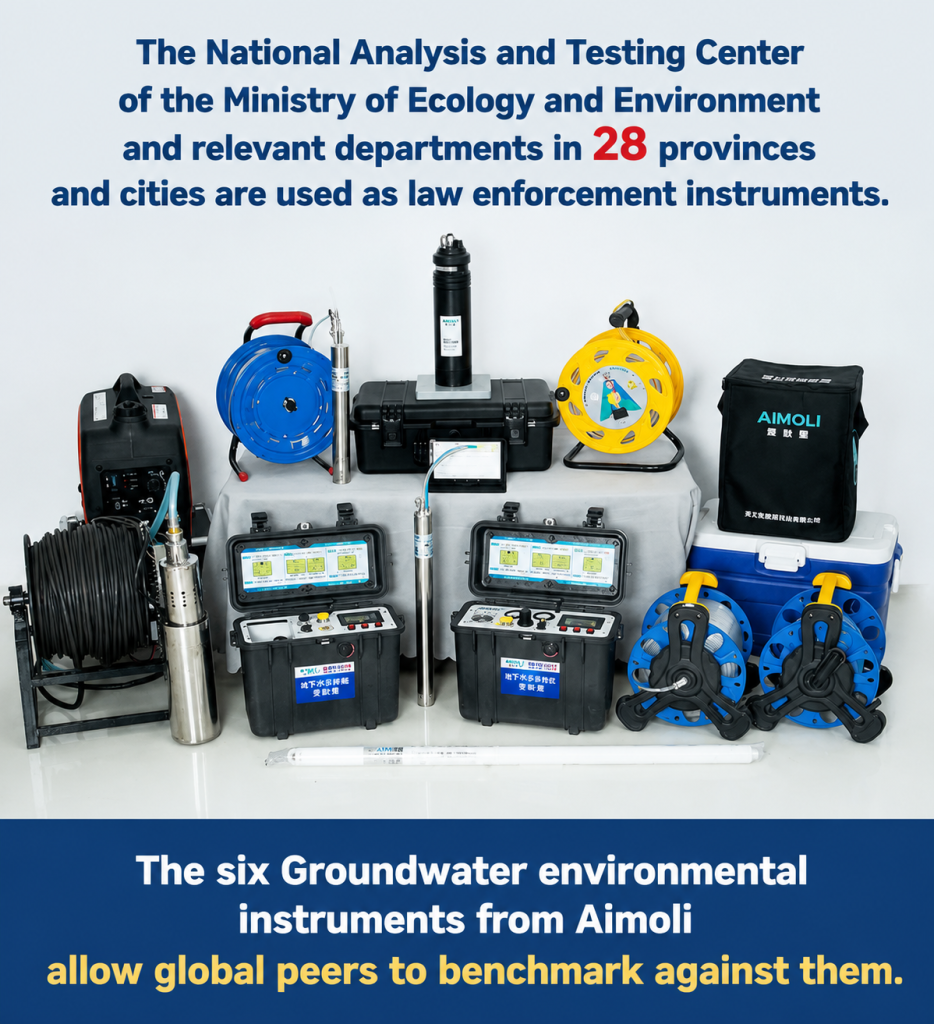
AIMOLI groundwater environmental instruments already have a certain reputation in the industry. The National Analysis and Testing Center of the Ministry of Ecology and Environment and relevant departments in 28 provinces and cities are using them as law enforcement instruments, while AIMOLI products are also recommended products under the national Belt and Road initiative.
Therefore, before purchasing the AML913 Interface Meter, Manager Zhao had already known about AIMOLI groundwater environmental instruments.
After we introduced the functions, technical solution, and quotation of the AML913 Interface Meter to Manager Zhao, he quickly decided to purchase the AML913 Interface Meter for his groundwater contamination monitoring project.
For third-party environmental monitoring companies that need to conduct large-scale groundwater monitoring and groundwater sampling, the core value of the AML913 Interface Meter is very clear:
One instrument, one downhole operation, and three sets of parameters—water level, well depth, and drawdown.
Compared with traditional groundwater monitoring, which requires three instruments and three downhole operations, the AML913 Interface Meter can significantly reduce repetitive work and increase monitoring efficiency by 300%.
At the same time, the AML913 Interface Meter has an IP68 protection rating, uses a probe made of 316L stainless steel, fluoro rubber, nylon, ABS, and Teflon, and can link with AML918 and AML919 groundwater samplers to control the groundwater well development and sampling processes.
If your project requires large-scale groundwater monitoring, groundwater contamination investigation, groundwater sampling, or groundwater well parameter measurement, the AML913 Interface Meter can help you reduce the number of instruments, reduce the number of downhole operations, and improve field groundwater monitoring efficiency.
AIMOLI Environmental Instruments, Precision That Sets You Apart!
