AIMOLI AML518 Microplastics Analyzer vs. Leading Global Brands — or, in other words, inviting global peers to benchmark against AIMOLI’s manufacturing capabilities in China
In 2027, ISO will release new standards for microplastics. AIMOLI has been invited to participate in the development of the new standards. This indicates that the AML518 Fully Automatic Microplastics Analyzer has already established a relatively authoritative position among global peers. In China, there should currently be no other peer manufacturer competing with AIMOLI at the same level.
AIMOLI AML518 Fully Automatic Microplastics Analyzer
I. Comparison of the Advantages and Disadvantages of the Three Major Global Technologies for Microplastics Analysis and Detection
1. Infrared Spectroscopy
Particles smaller than 10 µm are difficult to identify. Samples need to be prepared as dry films, making wet measurement impossible, and the equipment is very expensive. Accuracy is limited, and wet measurement cannot be performed.
2. Quantitative Mass Spectrometry
Pyrolysis–gas chromatography–mass spectrometry (Py-GC-MS) is a new technology capable of detecting nanoplastics, but it is extremely expensive. Once the sample is vaporized, repeated measurements cannot be performed.
3. Raman Spectroscopy
Raman spectroscopy can accurately identify different types of microplastics without sample pretreatment and can perform wet measurements. It is relatively affordable, offers high accuracy, and supports repeated measurements under wet conditions.
Many well-known peers claim to offer “nanoscale” detection. However, Chinese and international experts, as well as professors and PhDs from research institutes in various countries, have not seen this type of instrument actually analyze nanoplastics at the nanoscale. Whether nanoplastics can truly be detected at the nanoscale remains controversial, and it is not appropriate to categorically conclude that it is impossible.
II. Fully Automatic Integrated Microplastics Analysis and Detection Instrument Brands
1. First Tier: 5 Companies
These are mainstream research systems featuring fully automatic FTIR/Raman microplastics analysis, with the highest global market share.
1) Infrared Spectroscopy
- Bruker (Germany)
- Thermo Fisher (United States)
- Purency (Austria, small manufacturer)
2) Raman Spectroscopy
- HORIBA (Japan, nanoscale)
- Renishaw (United Kingdom)
2. Second Tier: 4 Companies
These are major comprehensive spectroscopy instrument manufacturers with mature supporting systems.
1) Infrared Spectroscopy
- PerkinElmer (United States)
- Shimadzu (Japan)
- Olympus (Japan)
2) Quantitative Mass Spectrometry
- Agilent (United States)
3) Raman Spectroscopy
- Shimadzu (Japan)
3. Domestic Fully Automatic Systems: 4 Companies
These systems combine fully automatic imaging with AI-based identification and are preferred options for budget-conscious users.
1) Raman Spectroscopy
- AIMOLI AML518
- Focused Photonics Inc.
- NCS Testing Technology
2) Quantitative Mass Spectrometry
- LabTech Genesis M1
III. Comparison Between AIMOLI AML518 and Raman Spectroscopy Brands
1. HORIBA (Japan, Nanoscale)
Semi-automatic: Samples require manual preparation, including filtration and sample mounting. The instrument automatically scans and identifies particles, but sample loading, cleaning, and report integration still require significant manual intervention or customized development.
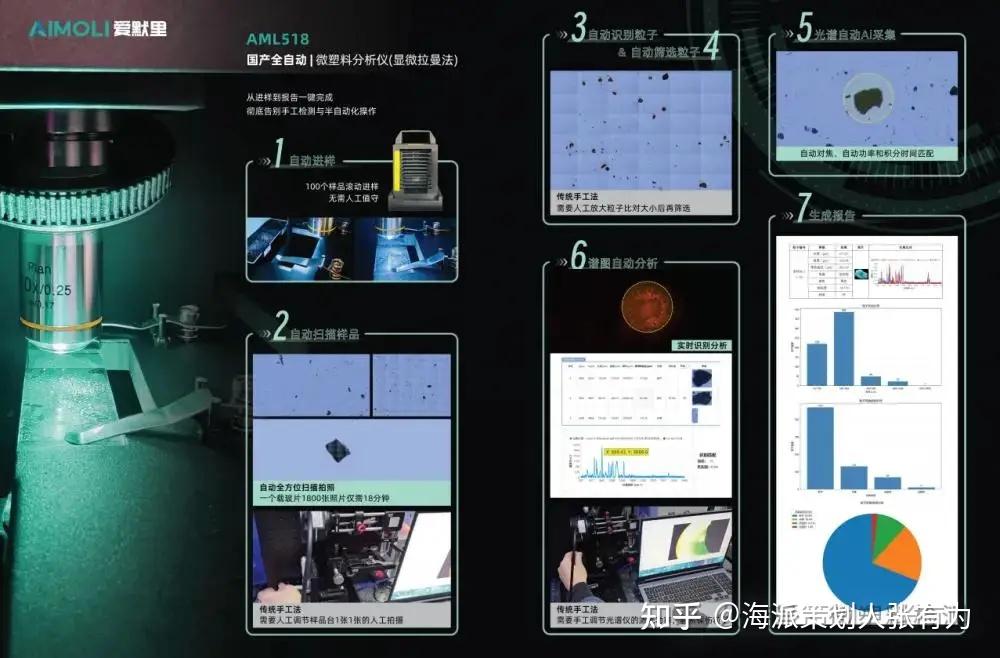
AIMOLI AML518 — Automation Level: Fully automatic. The system completes the entire process without human intervention, from slide loading, automatic focusing, and spectral scanning to report generation. It supports continuous loading of 100 samples.
2. Renishaw (United Kingdom)
In-Depth Analysis of Key Differences
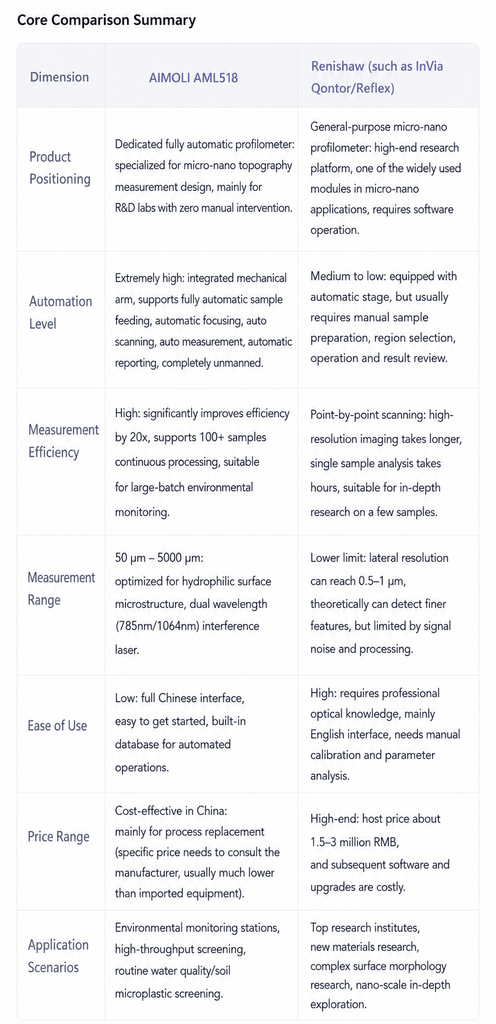
1) Technical Logic: Dedicated Integrated System vs. General-Purpose Platform
AIMOLI AML518 adopts an integrated solution combining microscopic imaging + Raman spectroscopy + robotic arm, creating a closed-loop workflow from pretreatment (after digestion, filtration, and sample preparation) to post-processing (report generation). Its core advantage is standardization. By using fixed workflows to eliminate human error, it is particularly suitable for routine monitoring tasks that comply with national and industry standards.
Renishaw provides underlying spectroscopy hardware and core algorithms. Although its inVia series is equipped with microplastics analysis software such as ParticleFinder, it essentially remains a “microscope + spectrometer” platform, requiring users to build their own workflows. Its advantage lies in flexibility, allowing users to customize laser wavelength, integration time, and confocal aperture to accommodate non-standard samples or research on special polymers.
2) Data Output and Reliability
AIMOLI AML518 outputs statistical data, including particle-size distribution, abundance, and polymer types, with an emphasis on batch consistency. According to official data, its recovery rates for 300 μm and 1000 μm particles reach 91% and 97%, respectively. However, its accuracy for extremely small particles (<50 μm) or strongly fluorescent matrices requires verification.
Renishaw outputs raw spectra and high-resolution chemical images, providing finer-grained data and supporting multivariate analysis and 3D morphology mapping. Its spectral resolution (≤1 cm⁻¹) and signal-to-noise ratio are industry-leading. The results are more authoritative and are often used as arbitration references, but they depend heavily on operator experience.
3) Operation, Maintenance, and Service
AIMOLI AML518, as a domestically manufactured instrument, offers fast response times, full Chinese-language support, and lower spare-parts costs, making it suitable for institutions with limited budgets that require rapid deployment.
Renishaw has longer after-sales service cycles and higher maintenance costs, but it has a comprehensive global technical support network, continuous software updates, and excellent long-term stability.
4) Selection Recommendations
Choose AIMOLI AML518: If your primary needs are routine environmental monitoring and high-volume sample screening, and you do not have dedicated spectroscopy experts, while prioritizing efficiency and reduced labor costs, this instrument is a more practical choice.
Choose Renishaw: If you are a top-tier research institution that needs to publish high-level academic papers, study microplastics <50 μm, analyze complex mixed matrices, or conduct mechanistic research, and you have professional operators, Renishaw’s high precision and flexibility are difficult to replace.
-624x1024.png)
3. Shimadzu (Japan)
Detailed Analysis of Differences
1) Differences in Technical Principles and Accuracy
Shimadzu: Uses the AIMsight infrared microscope as its core, combined with the MAP-100 automated pretreatment system. Infrared spectroscopy is considered the “gold standard” for qualitative microplastics identification, particularly for distinguishing polymer types and additives, and can detect particles as small as 10 μm. Its unique “plastic UV irradiation/pyrolysis aging spectral library” can effectively identify environmentally aged microplastics and reduce misidentification.
AIMOLI AML518: Uses microscopic Raman spectroscopy. Raman spectroscopy has the advantage of requiring no sample drying and supports wet measurement. Its dual-laser design (785 nm/1064 nm) can effectively suppress common fluorescence interference in environmental samples. However, its physical limitations make signal acquisition more difficult for small particles (<50 μm), with its primary measurement range covering 50–5000 μm.
2) Differences in Automation and Workflow
Shimadzu: Uses a separated model of automated pretreatment + automated analysis. MAP-100 automatically performs digestion, flotation, and filtration, while AIMsight automatically identifies measurement points and performs measurements. Although this reduces manual operations, the filter membrane or slide still needs to be transferred manually, making it a semi-automated workflow that is more suitable for scenarios with extremely high requirements for data quality.
AIMOLI AML518: Promotes the concept of a “lights-out laboratory.” Its built-in robotic arm directly handles slides and automatically completes microscope focusing, segmented imaging, spectral acquisition, and data interpretation. It supports continuous unattended operation of 10–100 samples. Its core selling point is labor reduction, compressing batch testing that would originally require several days into an hour-level process.
3) Application Scenario Recommendations
Choose Shimadzu when: You need to publish high-level SCI papers and the data must undergo international peer review; the application involves environmental enforcement, arbitration, or strict compliance with the latest national standards, such as T/SSESB 15-2025; the samples contain large amounts of aged or degraded microplastics; or you need to detect small particles <50 μm.
Choose AIMOLI AML518 when: The sample volume is extremely large, such as more than 100 water samples, and rapid abundance screening is urgently required. The laboratory lacks professional spectroscopy analysts and wants to lower the operational threshold. The budget is limited, and the primary focus is routine monitoring of particles above 50 μm, without extremely high requirements for data on the smallest particle sizes.
4) Purchasing Recommendations
If you prioritize data authority and research depth, the Shimadzu solution requires higher initial investment and has a somewhat more complex workflow, but its results are more reliable.
If you prioritize high-throughput screening and labor-cost reduction, the automation advantages of the AIMOLI AML518 are significant. However, it is recommended to conduct a blind-sample comparison test before actual procurement to verify whether the accuracy of its algorithm under the specific sample matrix meets the requirements of the project.
