Description: Traditional downhole cameras can barely be used for ordinary monitoring, but once the operating depth exceeds around 200 meters, many traditional downhole cameras will experience insufficient pressure resistance, blurry imaging, and transmission distortion due to problems with their own design, manufacturing processes, materials, and other factors, resulting in the embarrassing situation of being unable to see clearly or measure accurately. The AIMOLI AML921 downhole camera has a working depth of 500 meters and remains clearly visible at 500 meters, providing more reliable downhole video data for deep-well groundwater monitoring.
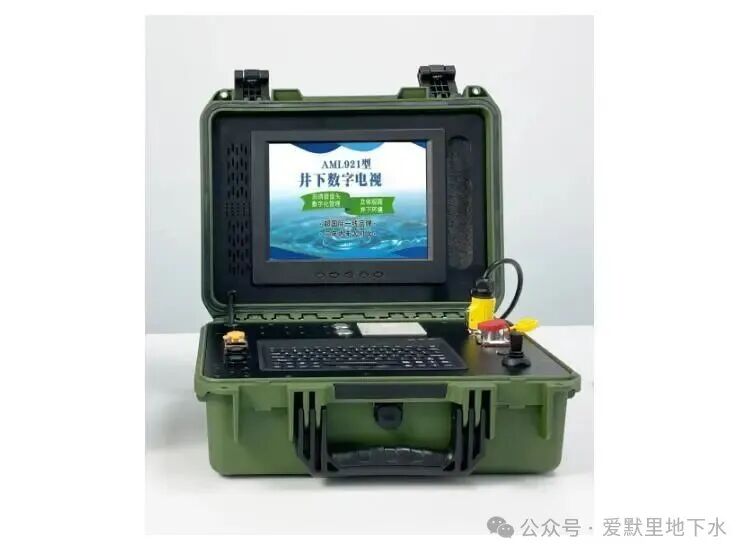
Traditional downhole cameras often experience low monitoring efficiency, unclear downhole images, and inaccurate measurements when operating in 200-meter-deep wells. An ecological and environmental monitoring center once contacted three manufacturers to solve the problem, but they were still unable to effectively resolve the deep-well monitoring issue. Finally, they used the AIMOLI AML921 downhole camera to achieve clear monitoring of the inside of the deep well.
For groundwater monitoring wells, deep wells, ecological and environmental monitoring wells, and other application scenarios, the pressure resistance, image clarity, signal transmission stability, and actual working depth of a downhole camera directly determine whether problems inside the well can be accurately identified. Especially in monitoring operations at depths of 300 meters, 400 meters, or even 500 meters, the difference between ordinary downhole cameras and professional deep-well downhole cameras becomes even more obvious.
I. Inability to See Clearly and Measure Accurately in Deep Wells Is a Common Disadvantage of Traditional Downhole Cameras
Last month, a groundwater monitoring station in Southwest China encountered a difficult problem. One of their groundwater monitoring wells showed abnormal water quality. The staff repeatedly flushed the well, but the data analyzed by the laboratory was still inaccurate.
Therefore, they began to suspect that the problem might not be with the groundwater itself, but that an abnormal condition had occurred inside the groundwater monitoring well.
They then contacted manufacturers and hoped to use traditional groundwater downhole cameras to inspect the inside of the monitoring well. However, they contacted three manufacturers in succession and still could not clearly see the internal condition of the monitoring well. Finally, Director Yu, who was responsible for the project, contacted us and hoped to solve the problem with professional deep-well downhole camera equipment.
Traditional downhole cameras can barely be used for ordinary monitoring, but once the operating depth exceeds around 200 meters, many traditional downhole cameras will experience insufficient pressure resistance, blurry imaging, and transmission distortion due to problems with their own design, manufacturing processes, materials, and other factors, ultimately resulting in the embarrassing situation of being unable to see clearly or measure accurately.
The depth of this abnormal groundwater monitoring well reached 380 meters. Such operating conditions were already far beyond the working limits of ordinary groundwater downhole cameras. Therefore, none of the three manufacturers previously contacted by Director Yu was able to clearly see the conditions inside the well at 380 meters.
This is also why, during deep-well groundwater monitoring, it is not enough to simply consider whether a downhole camera can “go down the well.” More importantly, it is necessary to determine whether the equipment can withstand pressure, provide clear imaging, and continuously transmit data at the actual operating depth.
II. What Are the Unique Advantages of the AIMOLI AML921 Downhole Camera?
To address the problems of unclear images and inaccurate measurements that often occur during deep-well monitoring, the AIMOLI AML921 downhole camera is designed for deep-well operating conditions and can be used in groundwater monitoring wells, deep-well inspections, and other applications.
1. High-Pressure Resistance and Deep-Well Operation Capability
The probe housing of the AML921 downhole camera is made of 316L stainless steel, providing corrosion resistance and durability and allowing it to adapt to various complex environments.
The probe diameter is ≤50 mm, with a total length of 50 cm. The camera observation window material can withstand pressure from a water depth of more than 100 meters, and the working depth reaches 500 meters while remaining clearly visible.
For groundwater monitoring wells at depths of 300 meters, 400 meters, or even 500 meters, whether the equipment can withstand deep-water pressure is one of the key factors in determining whether the downhole camera can operate normally. The AML921 downhole camera provides a stable equipment foundation for deep-well operations through its high-pressure-resistant design.
2. High-Definition Imaging and Digital Processing
The AML921 downhole camera is equipped with two high-performance cameras:
One camera is used to observe the well bottom, while the other camera is used to observe the well wall.
Combined with a fully automatic light-sensing system, it can keep the downhole image highly clear, allowing more accurate identification of conditions such as well wall damage and screen blockage.
At the same time, the AML921 also provides video recording and data export functions, allowing complete downhole monitoring data to be retained for subsequent video analysis, problem identification, and monitoring data preservation.
For groundwater monitoring projects, this is particularly important because the downhole camera not only needs to provide clear images in the field, but also needs to save complete video data to provide a basis for subsequent analysis and problem tracing.
3. Easy Operation
The AML921 downhole camera adopts an integrated design and integrates detection, storage, and other functions.
During actual operation, the equipment only needs to be lowered into the well. The two high-speed cameras can respectively perform real-time imaging and storage of the well bottom and well wall, directly presenting the actual conditions inside the deep well.
This means that staff can directly obtain downhole video information without complicated operations, thereby improving deep-well monitoring efficiency.
III. What Problem Caused the Abnormal Data in This Groundwater Monitoring Well?
After reaching an agreement with Director Yu, we immediately arranged for engineers to rush to the site for inspection.
Since the depth of the monitoring well reached 380 meters, our standard cable could not meet the requirements for deep-well operations at the site.
Therefore, we urgently started customized production and used a 400-meter special composite cable integrating load-bearing steel wire and signal transmission lines. At the same time, the waterproof connector was treated with glue filling and aging treatment to ensure stable operation of the equipment in the deep-well environment.
After 3 hours of on-site monitoring and video analysis, our engineers ultimately discovered three problem points:
(1) Mud had penetrated through the screen openings.
Through the high-definition well-wall observation camera of the AIMOLI downhole camera, mud penetration at the screen openings could be clearly identified.
(2) At 350 meters, the probe went black and touched the bottom. It was estimated that the bottom sediment had reached 30 meters.
When the probe descended to 350 meters, the screen went black and the probe touched the bottom. Based on the on-site monitoring conditions, it was estimated that the thickness of the sediment at the bottom of the well may have reached 30 meters. The abnormal groundwater quality was most likely caused by long-term mud sedimentation.
(3) There was an obstruction at the pipeline connection at 300 meters.
Through downhole video monitoring, an obstruction was also discovered at the pipeline connection at 300 meters. This is also a problem that is difficult to identify directly through traditional monitoring methods.
After seeing the actual downhole images on site, Director Yu immediately asked the staff to propose a repair plan based on the problems discovered on site.
Director Yu said, “No wonder there was abnormal data. It turned out that such serious conditions had already appeared underground. If we had not used the AIMOLI AML921 digital downhole camera, it would probably have been very difficult to discover the problem.”
This deep-well monitoring case once again demonstrates that for groundwater monitoring wells, deep wells, and ecological and environmental monitoring wells deeper than 300 meters, whether an ordinary downhole camera can truly provide clear and stable deep-well video monitoring is extremely important.
When the well depth reaches 380 meters or even deeper, if the equipment suffers from insufficient pressure resistance, blurry imaging, or signal transmission distortion, even if the probe can reach the bottom of the well, it is still difficult to obtain valuable downhole monitoring data.
The AIMOLI AML921 downhole camera has a 500-meter working depth, high-definition dual cameras, dual perspectives for the well bottom and well wall, video recording and data export functions, and can help staff understand the actual conditions inside deep wells more intuitively, providing more direct on-site evidence for investigating abnormalities in groundwater monitoring wells.
AIMOLI Environmental Instruments, Precision That Sets Us Apart!
