For many years, domestic research on microplastics analysis in water has relied heavily on imported brands. Most of these imported instruments are “general-purpose” instruments that cannot fully meet the specialized requirements of microplastics analysis in water. As a result, testing is time-consuming and labor-intensive, and human operation can easily introduce errors, seriously affecting testing efficiency and data accuracy. AIMOLI AML518 Microplastics Analyzer breaks the monopoly of imported brands by providing specialization, automation, and 24-hour unattended operation, significantly improving testing efficiency.
I. Water Microplastics Analysis Worldwide Mainly Uses Three Technologies:
1. Infrared Spectroscopy for Water Microplastics Analysis
Infrared spectroscopy is an analytical method based on the principle of molecular absorption spectroscopy. It cannot perform wet measurement and requires samples to be prepared as dry films, resulting in high costs. In addition, it is difficult to identify microplastics smaller than 10 µm.
2. Quantitative Mass Spectrometry for Water Microplastics Analysis
Quantitative mass spectrometry is a new quantitative detection technology based on thermal analysis and chromatographic-mass spectrometric separation principles. Although it provides the highest accuracy and can detect nano-scale plastics, the equipment is expensive and difficult to apply widely. Moreover, samples cannot be measured repeatedly after vaporization.
3. Raman Spectroscopy for Water Microplastics Analysis
Raman spectroscopy is a non-destructive testing technology based on the light-scattering effect. It offers high accuracy and can accurately identify different types of microplastics. It does not require complicated pre-treatment, does not destroy the sample, supports wet measurement and repeated measurement, and has a relatively lower cost.
II. Major Problems Facing Water Microplastics Analysis in the Industry
1. Heavy Dependence on Imported Microplastics Analyzers
At present, most domestic research institutions rely almost entirely on imported equipment, regardless of whether they use infrared spectroscopy, quantitative mass spectrometry, or Raman spectroscopy. Core equipment is dominated by foreign brands, and imported brands are expensive, making many water microplastics analysis and testing research projects extremely difficult.
2. Manual and Semi-Automated Operation Results in Very Low Efficiency
Whether domestic or imported microplastics analyzers are used in the industry, most are general-purpose instruments. These instruments are still at the manual or semi-automated stage and require dedicated personnel to operate them. Some microplastics analyzers require 3–4 hours to complete the analysis of a single sample, meaning one person can test a maximum of only 2–3 samples per day. The efficiency is very low. When dealing with large batches of samples, project schedules are often significantly delayed.
3. High Personnel Requirements and Susceptibility to Human Factors
Most procedures performed by these water microplastics analysis instruments require manual operation, including sample pre-treatment, particle screening, spectral detection, and data statistics. This is not only time-consuming and labor-intensive, but also makes it easy for human operation to introduce errors, seriously affecting testing efficiency and data accuracy. Therefore, operators need a high level of professional expertise, generally at least a postgraduate level.
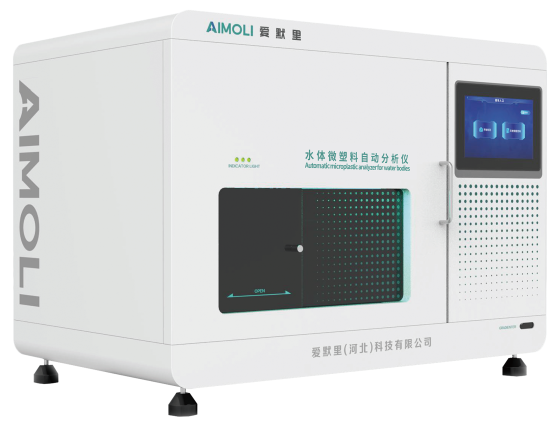
III. AIMOLI AML518 Fully Automatic Domestic Microplastics Analyzer
1. AIMOLI Uses Raman Spectroscopy Technology for Reliable Data
The AML518 uses a 785 nm laser wavelength with a laser power range of 0–500 mW, delivering excellent performance when exciting Raman signals from microplastics. Even when dealing with trace amounts or complex samples, it can quickly and clearly obtain spectral information.
Its resolution is <6 cm⁻¹, with a spectral range of 100–3500 cm⁻¹, enabling it to capture the spectral characteristics of microplastics in detail and accurately distinguish different types of microplastics.
With high stability and repeatability of ±1 cm⁻¹, the AML518 ensures that each testing result is accurate and reliable, providing a solid foundation for the scientific validity and authority of the data.
2. Fully Domestic Automated System, 24-Hour Unattended Operation, Significantly Improving Testing Efficiency
(1) True Full-Process Automation with No Manual Supervision Required
The AIMOLI AML518 fully automatic domestic microplastics analyzer achieves a fully unattended workflow covering sample loading → particle scanning → intelligent screening → automatic spectral acquisition → intelligent spectral analysis → report generation. The entire process runs automatically with one-click startup and requires no manual intervention.
(2) Eliminates Human Errors and Improves Data Accuracy
AI intelligently identifies particles, eliminating subjective errors, missed detections, incorrect detections, and differences in personnel judgment at the source. The data is stable, traceable, and comparable, meeting high standards for scientific research and testing.
(3) Significantly Improves Efficiency and Easily Handles Large Batches of Samples
The AML518 replaces manual particle screening and manual particle size measurement. Its daily testing throughput far exceeds that of traditional manual and semi-automated equipment, preventing laboratories from being held back by inefficient testing processes.
(4) Intelligent Spectral Analysis and Automatic Classification and Statistics
The system incorporates a professional spectral library and intelligent recognition algorithms to automatically determine polymer types and analyze size distribution, particle count, abundance, color, and morphology.
The AIMOLI AML518 fully automatic domestic microplastics analyzer breaks the monopoly of foreign brands and significantly improves testing efficiency.
AIMOLI Environmental Instruments — Precision That Meets the Urgent Needs of the Industry!
