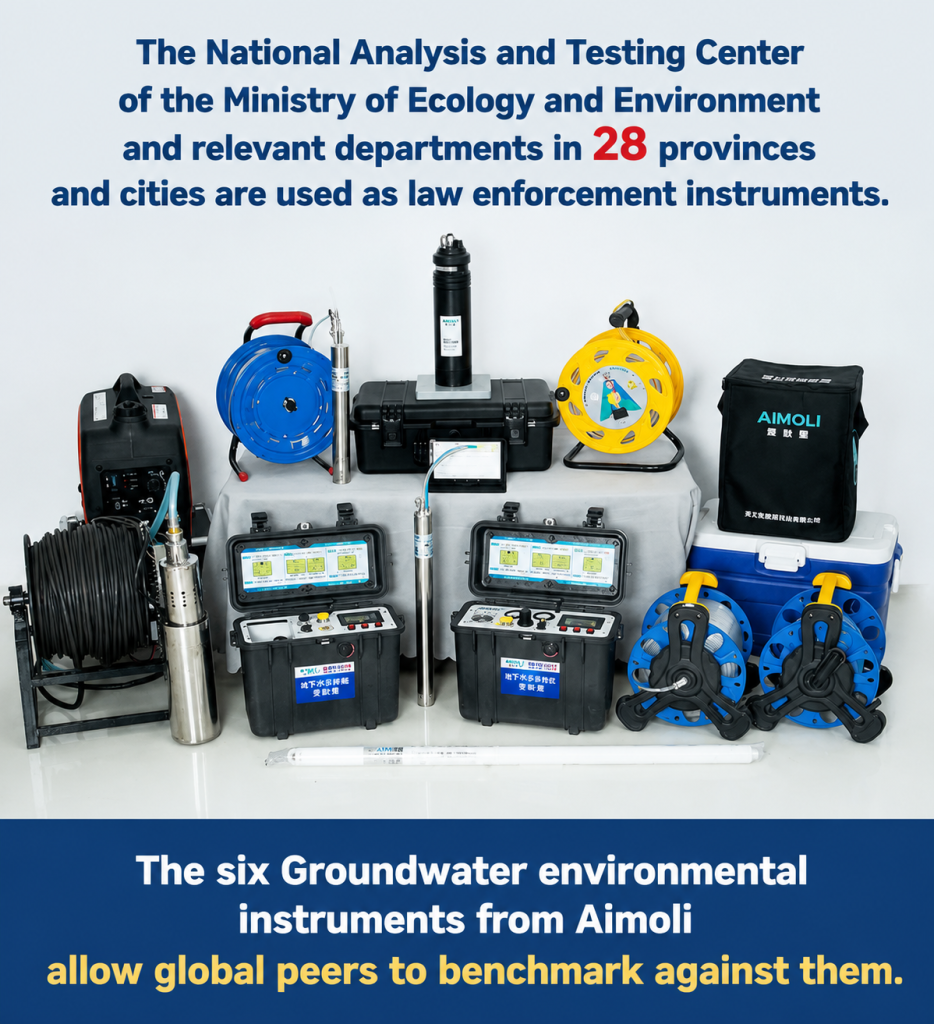
Last month, the AIMOLI team visited an environmental monitoring center in southern China to conduct training and demonstrations on the groundwater sampling system. The AIMOLI AML919 Groundwater Sampling System has been used for 3 consecutive years as the official training and examination equipment for the National Groundwater Sampling Qualification Certificate. It is also currently used as an enforcement instrument by the National Analysis and Testing Center of the Ministry of Ecology and Environment and relevant departments in 28 provinces and cities — with no equivalent.
Traditional groundwater sampling and monitoring equipment mainly has the following three problems:
First, low efficiency.
In the industry, whether it is domestic groundwater sampling equipment or imported groundwater sampling equipment, the vast majority still rely on fully manual sampling operations, resulting in very low efficiency.
The AIMOLI groundwater sampling and monitoring system, however, has already been upgraded with automation. The entire groundwater sampling process requires no continuous manual supervision, significantly reducing manual operations.
Some traditional groundwater sampling products have maintained the same design for decades without integrated improvements. For example, in traditional groundwater level monitoring, three separate devices are required to measure water level, well depth, and drawdown. The operating procedures are repetitive and waste manpower.
The AIMOLI AML Groundwater Three-Level Meter breaks through multiple technical barriers. Inside a probe about the size of a sausage, more than 20 precision components are integrated, combining a water level meter, well depth meter, and drawdown meter into one device. With only one deployment into the well, multiple parameters can be obtained, making the operation much more convenient and greatly improving work efficiency.
Second, unreliable data.
Unreliable data is mainly reflected in two aspects:
1. Subjective factors.
Some service providers use simple, low-quality groundwater sampling equipment that cannot meet actual requirements in order to reduce costs.
For example, when using traditional bailer sampling, the water sample comes into extensive contact with air when lifted from the water surface, making volatile losses highly likely. When using ordinary submersible pumps for water extraction, severe aeration can easily occur, resulting in unreliable data.
The AIMOLI AML919 Bladder Pump Groundwater Sampler, however, ensures that the entire sampling process has neither volatile loss nor cross-contamination interference. It is used as an enforcement instrument by the National Analysis and Testing Center of the Ministry of Ecology and Environment and relevant departments in 28 provinces and cities, ensuring reliable and guaranteed data quality.
2. Objective factors.
Due to limitations in manufacturing processes, principles, and algorithms, some equipment may produce unreliable data under certain conditions.
For example, groundwater flow velocity and direction meters used for monitoring often adopt the thermal pulse method. This method is greatly affected by water pressure, making it inaccurate when measuring groundwater flow velocity and direction at depths of 100 meters.
Even imported colloidal pipeline imaging groundwater flow velocity and direction meters, which use traditional particle tracing methods, can only clearly detect one type of water condition. When the water is either extremely turbid or extremely clear, the flow may not be visible.
The AIMOLI AML920 Colloidal Borescope Groundwater Flow Velocity and Direction Meter uses particle tracing measurement technology and can clearly visualize three types of water conditions. Whether the water is too clear, too turbid, or somewhere in between, it can clearly show water movement. Its performance even surpasses imported colloidal pipeline imaging groundwater flow velocity and direction meters.
Third, high cost and limited functions.
Before the launch of the AIMOLI groundwater sampling and monitoring system, many domestic research institutions and monitoring organizations mainly used imported instruments.
At that time, domestic instruments still had significant room for improvement and needed to learn from international brands. However, research and development require huge investment, and technological breakthroughs cannot be achieved overnight. The difficulty was so great that some manufacturers originally engaged in groundwater sampling and monitoring eventually abandoned independent R&D and became agents for foreign brands instead.
Relying on technological barriers, imported equipment is usually expensive and offers limited functionality.
After years of technological accumulation, AIMOLI has achieved localization of production, helping users significantly reduce costs. At the same time, some of our technologies have achieved breakthroughs, surpassing leading domestic brands, with product functions even stronger than those of top international brands.
For example, our AIMOLI AML916 Groundwater 6-Parameter Meter provides rapid on-site data output, automatically determines whether well purging has been completed, and complies with HJ164 and HJ1019 standards. It includes one additional turbidity and water level measurement function compared with imported instruments, surpassing leading international brands.
This training demonstration received high recognition from the user organization. The AIMOLI groundwater sampling system truly represents the brilliance of Chinese manufacturing.
AIMOLI Environmental Instruments — precision that makes competitors anxious!
