Professor Chen from a municipal ecological and environmental monitoring center recently faced a major challenge. His team received an urgent groundwater contamination risk investigation project, but with their existing personnel and equipment, completing the task on schedule was difficult. Therefore, they contacted AIMOLI for support.
Professor Chen’s project had three major challenges:
1. Extremely tight schedule
There were 12 monitoring wells in the target area, but the project deadline was only 10 days. Traditional monitoring methods required 4–6 hours to complete one well measurement. Considering travel time between locations, completing the entire project within the deadline was extremely challenging.
2. Inaccurate measurements
The underground environment in this area was complex. Traditional tracer methods were greatly affected by geological conditions, resulting in obvious data fluctuations and approximately 20% measurement errors, which seriously affected pollution source identification.
In addition, when water quality was either too clear or too turbid, even imported Colloidal Borescope groundwater flow meters could not provide clear observation results.
3. Multiple data collection requirements increased workload
Besides measuring groundwater flow velocity and direction, the team also needed to record changes in water temperature and water level while inspecting wells for potential leakage risks. Using traditional groundwater flow monitoring equipment would have made the project even more difficult to complete.
Based on Professor Chen’s requirements, AIMOLI recommended the AML920 Colloidal Borescope Groundwater Flow Velocity & Direction Meter.
First, compared with the 4–6 hours required by traditional methods, the AML920 usually completes one measurement within approximately 15 minutes, delivering a significant improvement in efficiency. Even including transportation time, monitoring 2–3 wells per day is completely achievable.
Second, traditional methods typically provide accuracy of around ±15%, while the AIMOLI AML920 achieves ±2% accuracy. Compared with imported Colloidal Borescope groundwater flow meters, AIMOLI uses particle tracking measurement technology, allowing clear observation even in extremely clear or highly turbid water conditions.
Finally, the AML920 comes standard with 6 measurement parameters, including groundwater flow velocity, flow direction, water temperature, water level, top-view well inspection, and 360° panoramic well imaging.
With its 3D vector algorithm, the AML920 can obtain three-dimensional groundwater flow vector data from a single monitoring well, while imported instruments are still limited to two-dimensional data analysis.
In 2018, groundwater flow velocity and direction meters were listed by China’s Ministry of Justice and Ministry of Ecology and Environment as essential equipment for soil and groundwater environmental damage forensic identification.
From both functionality and efficiency perspectives, the AIMOLI AML920 Colloidal Borescope Groundwater Flow Velocity & Direction Meter fully met Professor Chen’s project requirements.
Therefore, Professor Chen urgently purchased the AIMOLI AML920 Colloidal Borescope Groundwater Flow Velocity & Direction Meter.
During the 6-day field monitoring project, the performance of the AML920 greatly impressed Professor Chen’s team.
Colloidal Borescope The data collection process mainly included three steps:
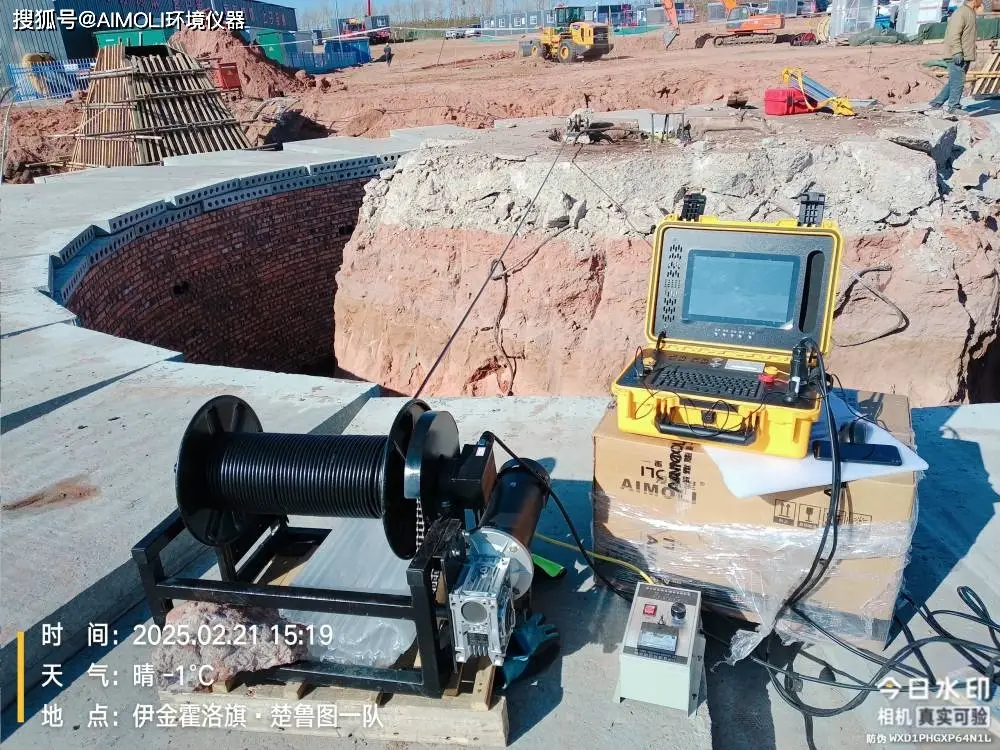
(1) Using a marked cable and lifting winch system, the multifunctional probe was lowered into the monitoring well to the target water level to capture particle movement information.
(2) Through visual algorithms and 3D vector algorithms, observation data was converted into groundwater flow velocity and direction information for real-time continuous measurement.
(3) Thousands of accurate, reliable, complete, fast, and updated data sets were collected every minute, ensuring sufficient statistical analysis.
With the help of the AIMOLI AML920 Colloidal Borescope Groundwater Flow Velocity & Direction Meter, Professor Chen’s team obtained not only groundwater flow velocity, flow direction, water temperature, and water level data, but also discovered through imaging data that three monitoring wells contained minor cracks.
These cracks were identified as potential pathways for contaminants entering groundwater.
Ultimately, Professor Chen’s team completed the project 4 days ahead of schedule, with 100% data completeness.
AIMOLI Environmental Instruments — Precision That Sets the Industry Standard.
