AIMOLI AML921 Downhole Camera Helps Accurately Assess Well Cleaning Needs
1. Project Background: How Can You Determine Whether a 1500-Meter Geothermal Well Needs Cleaning?
A geothermal company operates a geothermal well with a depth of 1500 meters. As the heating season approached, the operator wanted to identify potential wellbore issues in advance to ensure the normal operation of the geothermal system. To accurately understand the actual downhole conditions, the company contacted AIMOLI and used the AML921 downhole camera to conduct a visual inspection of the wellbore.
The geothermal well had been operating for many years. Previously, the operator mainly relied on surface water level and flow rate measurements to assess operating conditions. However, these parameters could only reflect overall operating trends and could not directly confirm specific problems inside the wellbore.
For example:
- Are the filter screen openings blocked? Have mineral scale or sediment deposits affected normal water flow?
- How severe is the downhole blockage? Is the blockage limited to a few sections, or are multiple areas experiencing significant problems?
- Has the reinjection capacity been affected? Are there any abnormalities inside the wellbore that may affect reinjection?
- Is well cleaning necessary? Should localized cleaning be performed, or should a full-well cleaning plan be developed?
If decisions are based solely on pumping test results, water levels, and flow rate data, it is often difficult to accurately locate downhole abnormalities. Blindly proceeding with well cleaning may increase chemical, labor, and construction costs, delay the project schedule, and even risk damaging the well casing if inappropriate procedures are used.
Therefore, before the heating season begins, obtaining actual downhole images through visual inspection became an important step in identifying wellbore problems and developing subsequent maintenance plans.
2. Inspection Challenges: What Requirements Does a 1500-Meter Deep Well Place on a Downhole Camera?
Inspecting a 1500-meter geothermal well tests not only the equipment’s deployment capability but also the pressure resistance of the probe, the load-bearing capacity of the cable, and the stability of long-distance signal transmission.
The main challenges of this inspection included the following:
1. Deep-well conditions require reliable equipment performance
As the deployment depth increases, the equipment must withstand the corresponding downhole pressure and temperature conditions. The probe and supporting system must have performance characteristics suitable for the actual operating environment.
2. Long-distance deployment requires cable safety
A detection depth of 1500 meters means that the cable must withstand its own weight and the tension generated during deployment. The cable structure, load-bearing capacity, and operating procedures all affect the stability of the inspection process.
3. Continuous, clear, and depth-referenced downhole images are required
Inspectors must not only observe the internal condition of the wellbore but also associate abnormal locations with their corresponding depths to support subsequent well cleaning and maintenance. Discontinuous images or inaccurate depth records can make it difficult to effectively guide on-site work.
3. Equipment Application: AML921 Downhole Camera Completes Visual Inspection of a 1500-Meter Geothermal Well
To address these requirements, the project used the AIMOLI AML921 downhole camera to conduct a full-wellbore visual inspection of the 1500-meter geothermal well.
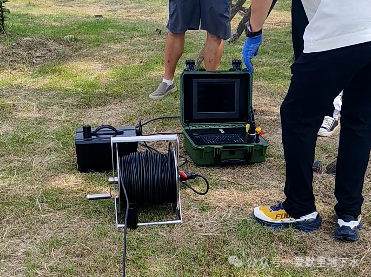
The AML921 downhole camera features a high-strength, pressure-resistant probe and an integrated load-bearing composite cable. During this project, it was successfully deployed to a depth of 1500 meters. Throughout the inspection, the surface display system presented downhole images in real time. Operators could pause deployment, record videos, and capture images as needed, while recording the corresponding inspection depths.
These functions enabled inspectors to associate actual images of the wellbore interior with depth information, making subsequent analysis and review more convenient.
The inspection focused on the following areas.
1. Inspecting Filter Screen Blockage
Filter screen openings are important components for water exchange in geothermal wells. After long-term operation, factors such as mineral scaling and sediment accumulation may affect their water-passing capacity.
By obtaining downhole images with the AML921 downhole camera, inspectors could visually examine the screen openings within the visible range, observe any obvious scaling, sediment accumulation, or other abnormalities, and determine the distribution of these abnormalities based on the recorded depths.
These images could help the operator further analyze blockage issues and provide a basis for selecting appropriate cleaning methods.
2. Observing the Condition of the Well Casing and Wellbore Interior
In addition to the filter screen openings, inspectors could use downhole images to observe the visible sections of the casing and wellbore, checking for obvious signs of corrosion, deformation, damage, or other abnormalities.
When abnormalities were identified, they could be recorded along with their corresponding depths, providing a reference for subsequent inspections, maintenance, and risk assessments.
It should be noted that a downhole camera is primarily used for visual inspection. Structural defects that cannot be confirmed directly through images, as well as issues such as the load-bearing capacity of the well structure, still require comprehensive assessment using other inspection methods.
3. Providing On-Site Evidence for Reinjection Capacity Analysis
For geothermal reinjection wells, reinjection capacity is affected not only by the internal condition of the wellbore but also by factors such as formation permeability, formation pressure, reinjection water quality, and operating conditions.
This inspection used downhole images to examine the visible condition of the wellbore and filter screen openings, helping the operator identify downhole abnormalities that might affect water exchange.
By combining the inspection findings with existing water level, flow rate, and reinjection operating data, the operator could analyze the causes of changes in reinjection capacity more comprehensively and avoid making decisions based on a single parameter.
4. Inspection Results: Providing Visual Evidence for Developing a Well Cleaning Plan
After completing the full-wellbore inspection, the operator obtained the corresponding downhole video footage and depth records. These materials could be used to further analyze the internal condition of the wellbore and assess subsequent maintenance requirements.
Compared with relying solely on surface operating parameters, downhole visual inspection provides supplementary direct image evidence, helping technical personnel develop more targeted treatment plans.
The inspection results provide the following benefits for geothermal well cleaning operations:
Identifying abnormal locations. Downhole images and depth records help locate well sections with obvious scaling, sediment accumulation, or other abnormalities, reducing the uncertainty of troubleshooting.
Optimizing well cleaning plans. Based on the distribution of abnormalities, together with water level, flow rate, reinjection tests, and other data, operators can assess whether well cleaning is necessary and whether localized treatment or full-well cleaning is appropriate.
Reducing the risk of unnecessary construction. For well sections where no obvious abnormalities are visible in the images, the necessity of treatment can be carefully evaluated in combination with other inspection results, helping avoid large-scale work without sufficient evidence. For areas with concentrated abnormalities, targeted cleaning plans can be developed.
Maintaining records for future operation and maintenance. Downhole videos and depth records can serve as image archives for this inspection, providing a reference for future reinspection, before-and-after cleaning comparisons, and analysis of changes in wellbore conditions.
It should be emphasized that downhole images can help identify visible abnormalities, but they cannot independently establish the actual water-passing capacity of the filter screens or the reinjection capacity of the formation. Final well cleaning decisions should still be based on a comprehensive assessment of hydraulic tests, operating data, and on-site conditions.
5. Project Value: Identifying Downhole Risks in Advance to Support Stable Heating Season Operations
After the 1500-meter geothermal well inspection was completed, the operator evaluated subsequent treatment plans based on the actual downhole images and existing operating data. This provided a more comprehensive basis for identifying wellbore risks and making maintenance decisions before the heating season began.
For geothermal heating projects, identifying potential internal wellbore abnormalities in advance helps operators schedule maintenance appropriately and reduces the time pressure associated with troubleshooting problems immediately before the heating season.
The application of the AIMOLI AML921 downhole camera in this project demonstrates the practical value of downhole visual inspection in geothermal well operation and maintenance: it transforms internal wellbore conditions that are difficult to observe directly into image records that can be viewed, documented, and reviewed, providing supporting evidence for wellbore inspections, well cleaning plans, and subsequent maintenance.
6. Which Geothermal Well Maintenance Scenarios Are Suitable for Downhole Cameras?
In addition to the 1500-meter geothermal well inspection described in this case study, downhole cameras can also be used in various applications that require visual observation of the wellbore interior. Their suitability depends on factors such as well depth, well diameter, downhole temperature, pressure, and water quality.
- Pre-heating-season inspections: Observe visible wellbore conditions in advance to support annual maintenance planning.
- Pre-cleaning inspections: Identify the locations and distribution of visible abnormalities to assist in developing well cleaning plans.
- Post-cleaning inspections: Compare images before and after treatment to assess changes within the visible range.
- Geothermal reinjection well inspections: Observe abnormalities inside the filter screens and wellbore to help analyze the causes of changes in reinjection capacity.
- Wellbore fault investigation: Check for obvious corrosion, deformation, damage, or other abnormalities within the visible range.
- Long-term maintenance records: Retain downhole images with depth information to support future inspections and condition comparisons.
7. Frequently Asked Questions (FAQ)
1. Can the AML921 downhole camera inspect a 1500-meter geothermal well?
In this project, the AIMOLI AML921 downhole camera was successfully deployed to a depth of 1500 meters and completed the corresponding downhole visual inspection. For other projects, suitability must be confirmed based on well diameter, depth, downhole temperature, pressure, cable configuration, and actual operating conditions.
2. Can a downhole camera directly determine whether a geothermal well needs cleaning?
A downhole camera can help identify visible scaling, sediment accumulation, and other abnormalities within the visible range, providing a reference for well cleaning decisions. However, whether cleaning is necessary, which method should be used, and how extensive the treatment should be must also be determined by comprehensively evaluating water levels, flow rates, reinjection tests, and other on-site data.
3. Why should a geothermal well undergo downhole visual inspection before cleaning?
Conducting downhole inspection before cleaning helps identify the locations and distribution of visible abnormalities inside the wellbore, assisting in determining which sections may require attention and improving the targeting of the cleaning plan. The inspection records can also serve as a reference for subsequent reinspection and treatment effectiveness comparisons.
4. Can the AML921 downhole camera detect filter screen blockage?
Downhole images can be used to observe obvious scaling, sediment accumulation, and other visible abnormalities in filter screen openings, with corresponding depths recorded. However, images cannot fully reflect the actual water-passing capacity of the openings or independently quantify the entire extent of blockage. Further evaluation through other inspection methods and hydraulic tests may be necessary.
5. Can a downhole camera determine why the reinjection capacity of a geothermal well has decreased?
A downhole camera can help identify abnormalities within the visible range of the wellbore and filter screens. However, reinjection capacity is also affected by factors such as formation permeability, pressure, and water quality. Therefore, reinjection operating data and relevant tests must be combined to comprehensively analyze the causes of reduced reinjection capacity.
6. What types of wells are suitable for the AML921 downhole camera?
Depending on the equipment configuration and actual operating conditions, its application can be evaluated for geothermal wells, reinjection wells, and other well types requiring visual inspection of the wellbore interior. Before selecting the equipment, the well depth, diameter, temperature, pressure, and other technical requirements should be confirmed.
Conclusion
Geothermal well operation and maintenance should not rely solely on surface water level and flow rate data. For long-running geothermal wells and reinjection wells, downhole visual inspection provides supplementary image records that help operators gain a more comprehensive understanding of internal wellbore conditions.
The AIMOLI AML921 downhole camera provides supporting evidence for wellbore inspections and well cleaning decisions through real-time imaging, video recording, image capture, and depth recording.
If you are conducting geothermal well maintenance, reinjection well troubleshooting, or pre- and post-cleaning inspections, you can evaluate the suitability of a downhole camera based on your actual well conditions. This makes wellbore inspections more intuitive and provides a more comprehensive reference for subsequent maintenance planning.
