In groundwater monitoring, environmental investigation, monitoring well purging, and groundwater sampling, field personnel usually need to know temperature, pH, dissolved oxygen, electrical conductivity, oxidation-reduction potential, and turbidity at the same time. If each parameter is measured with an independent instrument, more equipment needs to be carried to the field, and the number of field operations and data processing tasks will also increase.
Therefore, multiparameter meters have become a practical type of equipment for groundwater field testing. Compared with single-parameter instruments, multiparameter meters can integrate multiple sensors into the same system and obtain multiple groundwater parameters during one field operation.
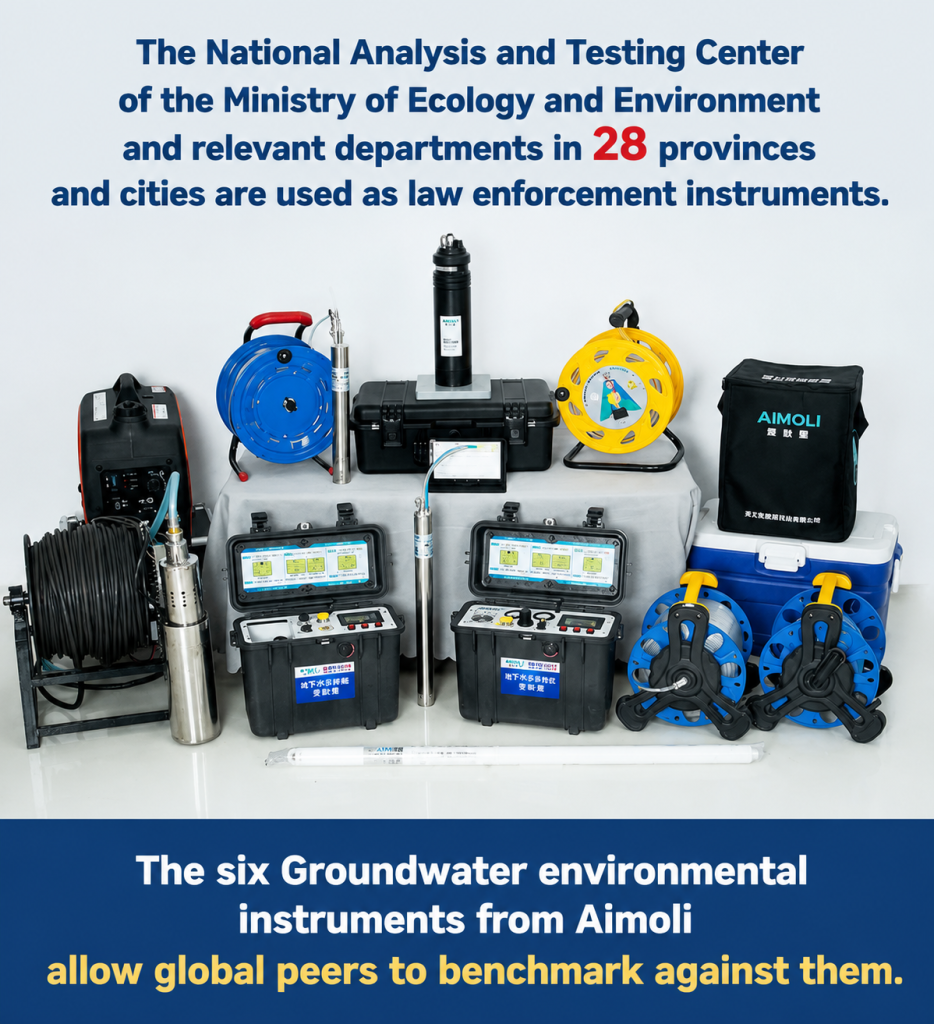
AIMOLI AML916 Groundwater Six-Parameter Measuring Instrument is a multiparameter water quality meter designed for this application. The equipment can simultaneously measure temperature, pH, dissolved oxygen (DO), oxidation-reduction potential (ORP), electrical conductivity (EC), and turbidity, and can assist personnel in determining whether well purging is complete through field data collection and stability judgment.
1. What Are Multiparameter Meters?
Multiparameter meters can be understood as multiparameter measuring instruments or multiparameter water quality testing instruments. They use multiple sensors to measure water parameters simultaneously or continuously, and display and record different parameters in a centralized way.
For groundwater monitoring, simply looking at one parameter is often not enough to determine the field condition of groundwater. For example:
- Temperature can reflect groundwater temperature changes;
- pH is used to determine acidity or alkalinity;
- DO is used to observe dissolved oxygen conditions;
- ORP is used to understand oxidation-reduction conditions;
- EC can reflect changes in water conductivity;
- Turbidity can reflect changes in suspended particles in water.
Therefore, using a multiparameter water quality meter for continuous monitoring before groundwater sampling can provide more complete field data.
AML916 is a professional groundwater multiparameter meter, mainly used for groundwater monitoring, monitoring well purging, groundwater sampling preparation, environmental investigation, and groundwater quality field testing. The core application is not simply to “measure several numbers,” but to use continuous changes in data to assist in determining whether groundwater has reached a stable condition.
2. AML916 Groundwater Multiparameter Meter Product Introduction
AML916 is a groundwater six-parameter measuring instrument mainly designed for groundwater field monitoring and sampling preparation.
The instrument can obtain the following six parameters at one time:
| Measurement Parameter | English Name | Main Purpose |
|---|---|---|
| Temperature | Temperature | Record groundwater temperature |
| pH | pH | Determine water acidity or alkalinity |
| Dissolved Oxygen | DO | Observe groundwater dissolved oxygen conditions |
| Oxidation-Reduction Potential | ORP | Determine oxidation-reduction conditions |
| Electrical Conductivity | EC | Reflect water conductivity |
| Turbidity | Turbidity | Determine changes in suspended particles |
An important feature of AML916 is the integration of turbidity measurement. For field work that requires groundwater well purging and sampling preparation, turbidity data can be used as an important reference for determining changes in water conditions.
At the same time, AML916 supports setting comparison time and data conditions. Based on continuous measurement results, it can assist personnel in determining whether groundwater has reached a stable condition. When the set conditions are reached, the instrument can provide a prompt to the operator, reducing reliance on experience alone to determine when well purging is complete.
Core Functions of AML916
The AML916 multiparameter water quality meter mainly includes the following functions:
- Groundwater six-parameter field measurement;
- Rapid field data collection;
- Continuous monitoring of groundwater parameter changes;
- Setting data comparison time;
- Assisting in determining stable conditions according to set conditions;
- Measurement data recording;
- Groundwater data processing;
- Wireless terminal operation;
- Field calibration;
- Well purging condition determination before groundwater sampling.
Therefore, multiparameter meters are not simply traditional water quality testing tools, but can also become data collection equipment in the groundwater field sampling process.
3. Why Does Groundwater Monitoring Need Multiparameter Meters?
Traditional groundwater field testing often requires personnel to carry multiple instruments separately.
For example, if pH, DO, electrical conductivity, ORP, temperature, and turbidity need to be measured, it is necessary to consider the calibration, operating methods, data recording methods, and equipment maintenance of different instruments.
Using multiparameter meters can integrate multiple measurement projects into one equipment system.
1. Reduce the Number of Field Equipment
One multiparameter water quality meter can complete multiple parameter measurements without preparing a separate instrument for every parameter.
This is especially important for projects that require multiple monitoring wells to be tested continuously in the field.
2. Reduce Repetitive Operations
Multiple parameters can be measured in a centralized manner, reducing repeated instrument replacement, repeated sensor lowering, and manual data recording.
3. Make It Easier to Observe Parameter Changes
During groundwater well purging, field personnel need to pay attention not only to the data at one specific moment, but also to changes in parameters over time.
Multiparameter meters can continuously collect data, making it easier for personnel to determine whether groundwater parameters are gradually becoming stable.
4. Facilitate Field Data Management
AML916 is equipped with professional groundwater analysis software, which can be used for data collection, recording, processing, and field analysis. The instrument also supports wireless terminals for calibration, equipment monitoring, and data management.
4. How to Choose Multiparameter Meters? Focus on These Parameters
When purchasing multiparameter meters, you should not only look at how many parameters the instrument can measure. More importantly, you should confirm whether the instrument is truly suitable for your groundwater monitoring process.
1. First Determine Which Parameters Need to Be Measured
If the project only needs to measure pH and electrical conductivity, there is no need to choose a complex six-parameter instrument.
However, for groundwater sampling, environmental investigation, or monitoring well purging, it is usually necessary to pay attention to:
- Temperature;
- pH;
- DO;
- ORP;
- EC;
- Turbidity.
In this case, a six-parameter multiparameter water quality meter is more suitable.
2. Pay Attention to the Turbidity Parameter
Some groundwater monitoring projects require not only pH, DO, ORP, EC, and temperature, but also observation of turbidity changes.
Therefore, when choosing multiparameter meters, you should confirm whether the product includes turbidity measurement.
AML916 integrates turbidity as the sixth parameter into the groundwater testing system, reducing the need to configure an additional independent turbidity meter.
3. Pay Attention to the Stability Judgment Function
For groundwater sampling, continuous changes in field data are very important.
If the instrument can only display current data but cannot compare data over a certain period, field personnel still need to manually record data at multiple time points and then determine whether the data are stable.
AML916 supports setting comparison time and data conditions, and can assist in determining stable conditions based on measurement results.
Therefore, if the equipment is mainly used for monitoring well purging and groundwater sampling, it is recommended to prioritize multiparameter meters with data stability judgment functions.
4. Pay Attention to Data Recording Methods
Field testing often involves multiple monitoring wells. If every measurement relies on paper records, the data must later be entered into a computer again.
When choosing a multiparameter water quality meter, you should pay attention to:
- Whether measurement data can be saved;
- Whether data processing is supported;
- Whether a wireless terminal is supported;
- Whether field calibration is supported;
- Whether analysis software is provided.
These functions directly affect the efficiency of subsequent data organization.
5. Main Technical Parameters and Configuration of AML916
The core measurement parameters of AML916 include six items:
Temperature + pH + DO + ORP + EC + Turbidity
| Item | AML916 Configuration |
|---|---|
| Product Type | Groundwater Six-Parameter Measuring Instrument |
| Number of Parameters | 6 |
| Temperature | Supported |
| pH | Supported |
| DO | Supported |
| ORP | Supported |
| EC | Supported |
| Turbidity | Supported |
| Field Data Collection | Supported |
| Stability Judgment | Supported |
| Data Recording | Supported |
| Data Processing | Supported |
| Professional Analysis Software | Supported |
| Wireless Terminal | Supported |
| Main Applications | Groundwater Monitoring, Well Purging, Groundwater Sampling Preparation |
It should be noted that when purchasing equipment for an actual project, you should not only look at the number of parameters. You should also further confirm the specific sensor range, accuracy, resolution, calibration requirements, cable length, and field working environment.
If the project has specific technical requirements, the latest technical specification sheet should be requested from the supplier before purchasing, and the configuration should be confirmed according to the project requirements.
6. Working Process of Multiparameter Meters
When using multiparameter meters for groundwater field work, the following process can generally be followed:
Monitoring Well Preparation
↓
Start Well Purging
↓
Place the Multiparameter Sensor
↓
Continuously Measure Groundwater Parameters
↓
Record Temperature, pH, DO, ORP, EC, and Turbidity
↓
Compare Continuous Measurement Data
↓
Determine Whether Groundwater Parameters Are Stable
↓
Conduct Sampling After Requirements Are Met
The core function of AML916 is to continuously provide field data during this process and assist in determining stable conditions according to the set time and data conditions.
7. Installation and Field Use of Multiparameter Meters
Step 1: Check the Equipment
Before use, check:
- Whether the main unit is functioning normally;
- Whether the sensors are complete;
- Whether the cable is damaged;
- Whether the battery level is sufficient;
- Whether the sensors need calibration;
- Whether data storage is functioning normally.
If the equipment has not been used for a long time, it is recommended to conduct a complete inspection before entering the field.
Step 2: Calibrate the Sensors
Sensors such as pH, DO, and electrical conductivity need to be calibrated according to the equipment instructions.
Standard solutions or calibration conditions that meet the requirements should be used during calibration.
After calibration, do not directly skip the field check. Confirm that the displayed data are normal.
Step 3: Place the Sensor into the Monitoring Well
According to the monitoring well depth and field operating requirements, place the sensor at the specified position.
During operation, avoid allowing the sensor to collide with the well wall or well bottom to reduce mechanical impact on the sensor.
Step 4: Start Continuous Monitoring
After starting the multiparameter meters, observe the changes in the six parameters.
The focus should not only be on a single instantaneous data value, but on whether different parameters tend to become stable over a period of time.
Step 5: Record and Determine
AML916 supports setting comparison time and data conditions.
The instrument can compare continuous data and provide a prompt to the operator when the set stability conditions are reached.
Step 6: Complete Sampling Preparation
After confirming that the data meet the project requirements, groundwater sampling can be conducted according to the project requirements.
It should be emphasized that the instrument provides a basis for field measurement and stability judgment. Specific sampling conditions should still follow project standards, monitoring plans, and local regulations.
8. Frequently Asked Questions About Multiparameter Meters
Q1: What water quality parameters can multiparameter meters measure?
Different models of multiparameter meters measure different parameters.
AML916 is mainly used for groundwater monitoring and can measure:
Temperature, pH, dissolved oxygen, ORP, electrical conductivity, and turbidity.
Q2: Is AML916 suitable for groundwater sampling?
Yes.
One of the main applications of AML916 is field parameter testing and well purging stability judgment before groundwater sampling. It can continuously collect six groundwater parameters and assist in determining whether groundwater has reached a stable condition according to set conditions.
Q3: Why does groundwater monitoring need turbidity measurement?
Turbidity can reflect changes in suspended particles in water.
During monitoring well purging, water conditions may continue to change. Observing turbidity together with pH, DO, ORP, EC, and temperature can provide more complete field information.
Therefore, for groundwater monitoring projects, a multiparameter water quality meter with turbidity measurement provides practical value.
Q4: How often do multiparameter meters need to be calibrated?
There is no fixed interval that applies to all projects.
Calibration frequency needs to be determined according to the sensor type, frequency of use, water conditions, project requirements, and equipment instructions.
If the equipment is used continuously for a long period, or if the testing environment changes significantly, the calibration and inspection frequency should be increased according to actual conditions.
Q5: What should I do if field data are unstable?
First check:
- Whether the sensors have been correctly calibrated;
- Whether the sensors are fully immersed at the required position;
- Whether there is contamination on the sensor surface;
- Whether there is a cable contact problem;
- Whether the water itself is still undergoing significant changes;
- Whether the required stability time has been reached.
Do not directly determine that the equipment is faulty just because the data are changing. First distinguish between “the water has not stabilized” and “the equipment measurement is abnormal.”
Q6: Why does the pH data keep changing?
Changes in pH may come from the water itself or may be related to sensor conditions.
It is recommended to check the calibration status, sensor cleanliness, measurement position, and whether the field water has already stabilized.
If other parameters are also changing significantly at the same time, the first consideration should be that the water has not yet reached a stable condition.
Q7: Can multiparameter meters replace all laboratory testing?
This cannot be understood simply in this way.
Multiparameter meters are mainly used for rapid field measurement and field data collection.
For pollutants, organic compounds, heavy metals, or other specific indicators that require laboratory analysis, laboratory testing should still be conducted according to project requirements.
9. Common Faults and Troubleshooting of Multiparameter Meters
Fault 1: No Data for a Certain Parameter
Possible causes include:
- Abnormal sensor connection;
- Sensor not fully immersed;
- Abnormal sensor condition;
- Equipment failing to correctly recognize the sensor;
- Abnormal calibration data.
It is recommended to check the connection and sensor condition again, and then recalibrate according to the operating instructions.
Fault 2: Significant Data Drift
If one parameter continues to drift, check whether there is contamination or air bubbles on the sensor surface, and confirm whether the field water has stabilized.
For groundwater field work, it is not recommended to directly attribute all data changes to equipment failure.
Fault 3: Abnormal Turbidity Data
Turbidity sensors can be affected by water particles, air bubbles, and contamination on the sensor surface.
The following steps can be taken:
- Check the sensor surface;
- Remove attached materials;
- Check the installation position;
- Confirm whether the water contains a large amount of suspended particles;
- Perform necessary calibration or testing again.
Fault 4: Wireless Terminal Cannot Connect Normally
Check:
- Whether the wireless function is enabled;
- The distance between the equipment and terminal;
- Terminal software status;
- Equipment battery level;
- Wireless connection configuration.
AML916 supports wireless terminals for field calibration, equipment monitoring, data recording, and data processing, making wireless connection an important part of field data management.
10. What Should You Pay Attention to in Multiparameter Meters After-Sales Service?
When purchasing multiparameter meters, do not only compare equipment prices.
Groundwater monitoring equipment is professional equipment designed for long-term use. The factors that actually affect the cost of use include:
- Sensor service life;
- Calibration service;
- Repair response speed;
- Spare parts supply;
- Software support;
- Operation training;
- Technical parameter confirmation;
- Field troubleshooting.
Especially for environmental monitoring companies and third-party testing organizations, if equipment failure causes project downtime, the resulting cost may be much higher than a single repair cost.
Therefore, when choosing a multiparameter water quality meter, the after-sales service process should be confirmed in advance.
11. Practical Application Case: Groundwater Monitoring and Well Purging
Suppose an environmental monitoring project needs to sample multiple groundwater monitoring wells.
The traditional workflow may require field personnel to carry multiple instruments, test different parameters separately, and then manually record the data.
If the project needs to observe temperature, pH, DO, ORP, EC, and turbidity at the same time, more field operations are required.
After using AML916, six parameters can be collected centrally through one set of multiparameter meters.
The field workflow can become:
Monitoring Well → Well Purging → AML916 Continuous Monitoring → Six-Parameter Data Recording → Stability Judgment → Groundwater Sampling
The value of this working method is mainly reflected in reducing repetitive operations, centralized data recording, and improving field judgment efficiency, rather than simply adding another measurement parameter.
AML916 is mainly used for groundwater monitoring, monitoring well purging, groundwater sampling preparation, environmental investigation, and groundwater quality monitoring.
12. Multiparameter Water Quality Meter vs. Single-Parameter Instruments
| Comparison Item | Single-Parameter Instruments | Multiparameter Meters |
|---|---|---|
| Measurement Parameters | Usually fewer | Multiple parameters integrated |
| Number of Equipment | Multiple instruments | One system for multiple projects |
| Field Operation | More operations | More centralized operation |
| Data Recording | Need to organize separately | Can be recorded centrally |
| Continuous Monitoring | Depends on the equipment | More suitable for multiparameter continuous monitoring |
| Groundwater Well Purging | Requires multiple instruments | More suitable for comprehensive field monitoring |
| Parameter Stability Analysis | Usually requires manual judgment | Can be combined with data for judgment |
| Application Scenario | Single-parameter testing | Comprehensive groundwater field monitoring |
If only one parameter needs to be tested occasionally, a single-parameter instrument may be simpler.
If a project requires multiple groundwater parameters to be measured at the same time, especially when well purging and pre-sampling stability judgment are required, multiparameter meters are more suitable for the actual workflow.
13. Why Choose AML916 as Groundwater Multiparameter Meters?
The product positioning of AML916 is relatively clear: it does not simply pursue the number of measurement parameters, but establishes a complete data collection process around groundwater field monitoring and sampling preparation.
Its main advantages include:
Six-Parameter Centralized Measurement
Temperature, pH, DO, ORP, EC, and turbidity are integrated into one equipment system.
Stability Judgment Support
Users can set comparison time and data conditions and use continuous measurement results to assist in determining whether groundwater has reached a stable condition.
Data Recording Support
Field measurement data can be recorded and processed, reducing manual data organization.
Analysis Software
Professional groundwater analysis software is used for data collection, processing, and field management.
Wireless Terminal Support
Wireless terminals can be used for field calibration, equipment monitoring, and data management.
Suitable for Groundwater Field Work
The equipment is mainly designed around groundwater monitoring, well purging, and sampling preparation rather than simply general water quality rapid testing.
14. What Should Be Confirmed Before Purchasing Multiparameter Meters?
If you are preparing to purchase multiparameter meters, it is recommended to prepare the following information before requesting a quotation:
- Number of monitoring wells;
- Monitoring well depth;
- Well diameter;
- Parameters that need to be measured;
- Accuracy requirements for each parameter;
- Required data recording method;
- Whether a wireless terminal is required;
- Whether stability judgment is required;
- Monitoring standards adopted by the project;
- Frequency of use;
- Working environment;
- Whether software support is required.
In particular, do not simply tell the supplier, “I need a groundwater multiparameter meter.”
A more accurate purchasing method is to tell the supplier:
“It will be used for groundwater monitoring well purging and sampling. It needs to simultaneously measure temperature, pH, DO, ORP, EC, and turbidity, and requires field data recording and stability judgment.”
This makes it easier to obtain multiparameter meters that better match the actual work requirements.
15. Conclusion: What Problems Do Multiparameter Meters Really Solve?
For groundwater monitoring, multiparameter meters do not simply solve the problem of “one instrument measuring more parameters.”
What they really solve is:
Multiple Parameters → One Equipment System → Continuous Measurement → Data Recording → Stability Judgment → Sampling Preparation
AML916 uses six parameters—temperature, pH, DO, ORP, EC, and turbidity—to comprehensively monitor groundwater field conditions. It also supports stability comparison, data recording, software analysis, and wireless terminal operation.
If your work involves groundwater monitoring, monitoring well purging, environmental investigation, or groundwater sampling, when choosing a multiparameter water quality meter, you should focus on actual measurement parameters, sensor configuration, stability judgment, data management, and after-sales support rather than simply comparing equipment prices.
For projects requiring six groundwater parameters to be measured in the field, AML916 can serve as a professional multiparameter meters solution.
Product Name: AML916 Groundwater Six-Parameter Measuring Instrument
Core Parameters: Temperature + pH + DO + ORP + EC + Turbidity
Main Applications: Groundwater Monitoring, Well Purging, Groundwater Sampling Preparation, Environmental Investigation
