Recently, demand for groundwater flow velocity and direction monitoring has surged, and orders for the Aimerly AML920 Groundwater Flow Velocity and Direction Instrument continue to be fully booked, with delivery schedules already extending into next month.
Current industry monitoring conditions are increasingly moving toward deep and ultra-deep wells, with numerous projects requiring groundwater monitoring at depths of 500 meters and 1,000 meters. Traditional equipment can no longer meet the high standards required for deep well operations.
The AML920 Groundwater Flow Velocity and Direction Instrument, with its irreplaceable robust performance, has become the first-choice equipment for geotechnical surveys, subway construction, and hydrological monitoring projects, maintaining a leading position in the industry.
Looking at similar monitoring devices on the market, most have critical shortcomings that severely limit deep well monitoring capabilities:
- The vast majority of competing products are only suitable for shallow wells of 30–50 meters. Once the depth exceeds 60 meters, measurement accuracy drops sharply, data becomes chaotic, or devices fail to produce any readings at all.
- Their adaptability to different water bodies is poor, able only to measure conventional water types; they cannot function properly in clear or highly turbid waters.
- Their applicable scenarios are extremely limited and cannot meet the current demands of complex, deep monitoring environments.
Unique Advantages of the AML920 Groundwater Flow Velocity and Direction Instrument
The AML920 breaks industry technical barriers, featuring an exclusive “six-in-one” integrated composite probe, making it the only multifunctional, all-in-one monitoring device in the market today.
- It can simultaneously and precisely measure four core parameters: flow velocity, flow direction, water level, and water temperature.
- It is equipped with a top-down camera and a 360-degree annular well wall dual-camera system, capturing both dynamic water flow data and comprehensive visual monitoring of well walls, underground sediment, and fracture development—enabling multi-dimensional monitoring with a single device.
- It surpasses depth and water body limitations, easily adapting to ultra-deep well operations from 100 meters to 1,000 meters, accurately measuring both clear and turbid waters, making it suitable for all groundwater monitoring scenarios.
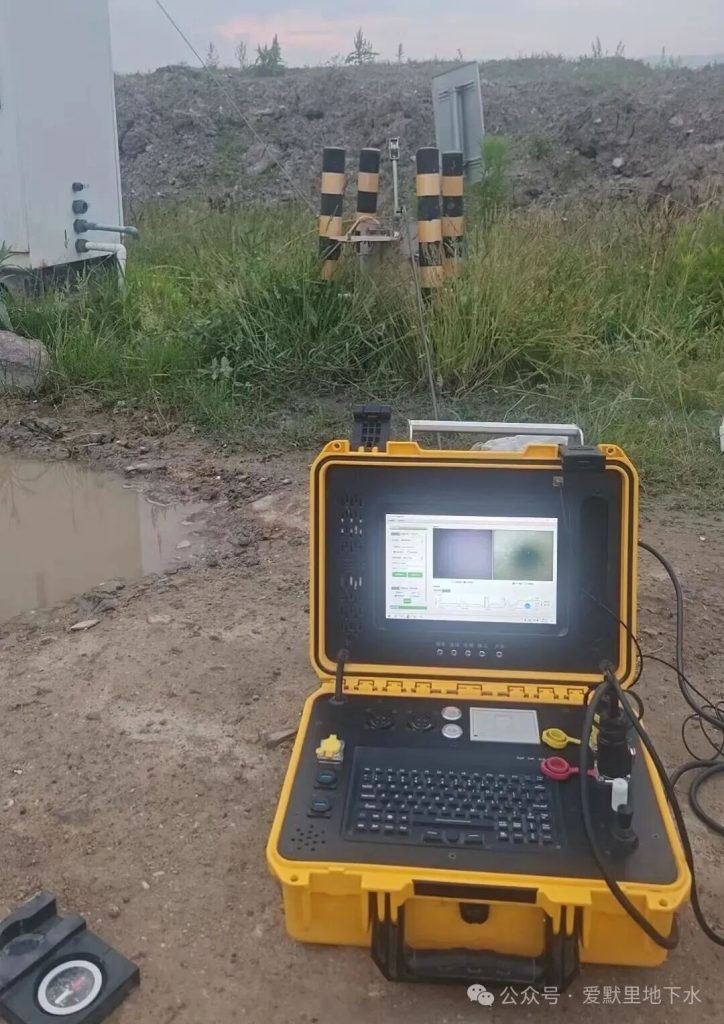
Customer Case
Recent on-site testing at a Guangzhou railway project clearly demonstrates the AML920’s unmatched performance. Four equipment units participated in the same test, including two competitors tested in the same wells at roughly 100 meters depth—typical deep well monitoring conditions.
The results were clear:
- Competing devices only produced basic data in shallow wells of 15 meters. At depths of 30, 50, and 60 meters, their data completely failed. At 100 meters, they could not produce any readings, halting monitoring operations entirely.
- The AML920 delivered stable and outstanding performance throughout:
- Accurate data output throughout the 100-meter deep well operation.
- Real-time, stable flow velocity and direction data, closely matching local geological and hydrological conditions.
- Continuous monitoring of four deep wells with zero equipment failure and zero data deviation, decisively outperforming competitors and earning high client recognition.
Why Choose AML920?
In today’s increasingly demanding conditions for construction surveys and hydrological monitoring, traditional shallow and limited monitoring equipment is gradually being phased out.
The AML920 Groundwater Flow Velocity and Direction Instrument, with its exclusive six-in-one integrated technology, kilometer-deep adaptability, compatibility with all water types, and precise, stable data, solves the long-standing challenges of deep well monitoring.
Proven on-site performance and reliable equipment quality are the core reasons behind its continued high demand and market leadership, making it the preferred benchmark for deep well groundwater monitoring among major design institutes and engineering firms.