Last week, I received a phone inquiry from Mr. Wang, a manager from Shandong Province, who wanted to learn more about AIMOLI groundwater well purging pumps.
After our conversation, I learned that Mr. Wang was an equipment distributor who had been entrusted by an end user to find suitable groundwater sampling and well purging equipment.
Considering that groundwater monitoring involves different field conditions, and that different applications have different requirements for equipment diameter, pumping head, flow rate, and actual operating performance, I did not rush to recommend a particular model. Instead, I first introduced AIMOLI’s full range of products to Mr. Wang, explaining the functions, features, and application scenarios of each model in detail.
To help the end user select the right equipment, I organized three key technical requirements and asked Mr. Wang to forward them to the customer for confirmation:
- Well purging type and field operating conditions: Identify the specific groundwater monitoring application for which the equipment will be used.
- Inner diameter of the monitoring well: The well diameter directly determines the required equipment dimensions and whether the pump can be lowered into the well.
- Specific application: Determine whether the equipment is intended for well development, sediment removal inside the well, or pre-sampling well purging before groundwater sampling.
Only after confirming these basic requirements can a suitable equipment solution be developed based on the actual field conditions.
1. Complete Field Conditions Received the Following Day
The following day, Mr. Wang sent me the complete field condition information provided by the end user.
After reviewing the information, I summarized the specific requirements of the project as follows:
- Application: Well purging before groundwater sampling.
- Monitoring well inner diameter: 50 mm, a commonly used monitoring well specification in the environmental monitoring industry.
- Well depth: The monitoring points are distributed across different outdoor locations and are relatively far apart. Most wells are no deeper than 70 meters, while a few reach a maximum depth of 80 meters.
- Groundwater level: Overall, the water levels are relatively shallow. Most are approximately 20–30 meters, while only two wells have water levels in the 50–60 meter range.
Based on these parameters, the customer needed equipment that could not only fit inside 50 mm small-diameter monitoring wells but also accommodate different well depths and groundwater level conditions.
In particular, the water levels at some monitoring points reached 50–60 meters, placing higher demands on the sampling pump’s continuous water discharge capability and operating stability.
2. Equipment Compatibility Problems Encountered by the Customer
During our further discussions, Mr. Wang also told me about the equipment compatibility problems the end user had encountered in previous projects.
In previous field operations, the customer had experienced unstable water discharge when working in certain monitoring wells with groundwater levels of 50–60 meters. Some sampling equipment had difficulty maintaining continuous water discharge and could not consistently meet the requirements of sampling operations.
At the same time, the actual discharge flow rate of a sampling pump can also be affected by operating conditions such as the lowering depth. For outdoor operations involving monitoring points distributed across different locations and frequent equipment transportation, the equipment must not only accommodate different well depths but also provide reliable continuous water extraction.
Therefore, the customer’s purchasing requirement was not simply to find a water pump that could fit inside a 50 mm monitoring well. They wanted a more adaptable groundwater sampling solution capable of handling different groundwater levels, well depths, and outdoor working conditions.
After reviewing all the technical parameters and previous equipment feedback provided by the customer, I compared the application ranges of AIMOLI’s different models. Finally, I recommended the AML918 Groundwater Sampling Pump to Mr. Wang as the primary solution.
3. Why Did I Recommend the AML918 Groundwater Sampling Pump?
Considering the project’s 50 mm monitoring wells, maximum well depth of 80 meters, and groundwater levels of 50–60 meters in some locations, I believed that the AML918 Groundwater Sampling Pump was particularly worth considering.
Key Product Specifications:
- Pump body diameter: 45 mm
- Overall length: 36 cm
- Model: AML918 Groundwater Sampling Pump
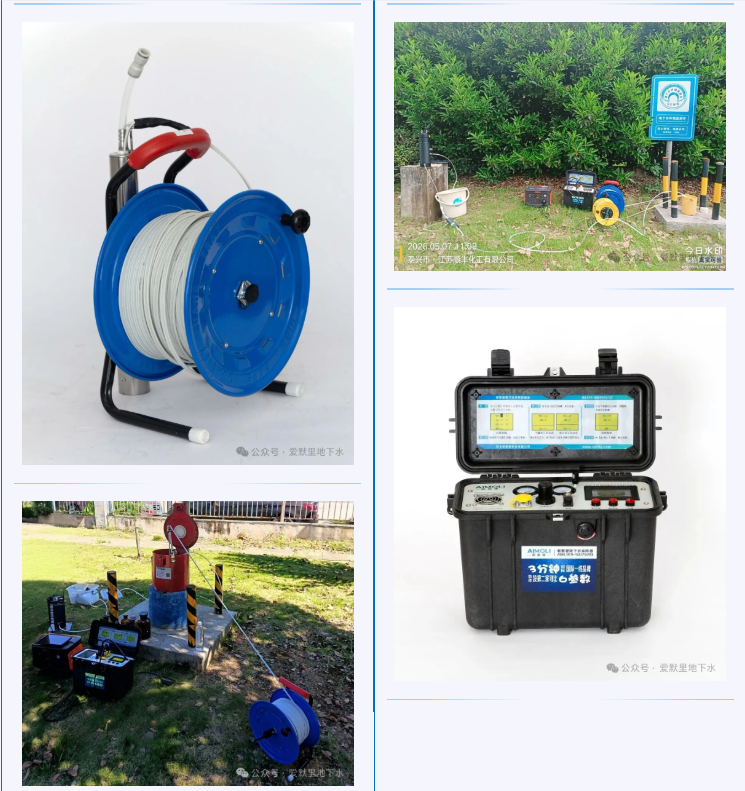
The 45 mm pump body provides the necessary dimensional compatibility for a monitoring well with a 50 mm inner diameter, while its compact overall length of 36 cm also facilitates lowering the equipment into small-diameter monitoring wells.
For more information about the product, please visit AML918 Groundwater sampling pump (0 pollution submersible pump.
In addition to its compact structural design, the AML918 has another specially optimized feature: the signal cable, power cable, and load-bearing cable are integrated into a single customized composite cable.
The outer surface of this composite cable is also printed with meter markings.
During actual well purging or groundwater sampling operations, field technicians can directly read the lowering depth of the pump using the markings on the cable. There is no need to carry additional measuring tools to determine the pump’s position.
For customers who work at widely distributed monitoring points and frequently conduct outdoor field operations, this design reduces the number of operating steps and makes fieldwork more convenient.
Traditional submersible pumps often require multiple separate lines to be installed during outdoor operations. When the pump is repeatedly lowered into and lifted out of a well, it can easily rotate underwater, causing multiple cables to become tangled or twisted together and creating difficulties for field technicians.
The AML918 adopts an integrated composite cable design, combining multiple functions into a single cable. This effectively reduces the operational burden associated with installing multiple lines and makes lowering, retrieving, and determining the pump depth more convenient.
This type of small-diameter application has also been discussed in another AIMOLI project: Case Study: Well Water Sampling from Narrow-Diameter Well Casings.
Product Stability Proven Through Years of Field Applications
In addition to its structural design, I also introduced the AML918’s actual application history to Mr. Wang.
This model has been available on the market for nearly ten years. Throughout its long-term market application, its product stability, quality control, and after-sales support system have undergone years of field testing.
Currently, the National Analysis and Testing Center of the Ministry of Ecology and Environment, as well as ecological and environmental regulatory authorities in 28 provinces and municipalities across China, use this product as a supporting instrument for on-site law enforcement.
These extensive long-term application cases from frontline users across different regions and working environments also provide solid practical evidence of the product’s performance and application value.
For additional technical information about the AML918 and its low-flow sampling applications, you can also read How AML918 Improves Low-Flow Groundwater Sampling.
To help the end user better understand the product, I also prepared detailed AML918 product information and examples of previous typical projects and forwarded them to the customer through Mr. Wang for further evaluation based on their actual working conditions.
4. From Equipment Selection to Purchase Agreement: The Customer Quickly Finalized the Solution
After sending the product information and project cases earlier that day, I received good news from Mr. Wang that afternoon: he and the downstream end user had already reached a purchasing agreement for the AML918 Groundwater Sampling Pump.
According to the information provided, the order value met the requirements for direct procurement, meaning that the end user did not need to initiate a bidding process. As a result, both parties quickly completed the purchase contract.
Based on the standard delivery lead time for the AML918, the company completed delivery of this batch of equipment within one week.
After the equipment arrived, the customer successfully completed the acceptance inspection, and the entire purchasing and delivery process went smoothly.
After putting the equipment into operation, the customer used the system to complete multiple rounds of groundwater sampling. According to subsequent feedback, the equipment performed stably and met the requirements of the actual field operations.
From the initial telephone inquiry to confirming the field conditions the following day, reaching a purchasing agreement that same afternoon, and completing delivery within one week, the cooperation progressed smoothly.
The key to this successful cooperation was that I did not simply recommend equipment based on the product model. Instead, I conducted a targeted analysis based on the customer’s monitoring well dimensions, groundwater levels, well depths, and actual operating requirements.
5. AIMOLI: Focused on Independent R&D of Groundwater Environmental Monitoring Instruments
As a technology company specializing in groundwater environmental monitoring, AIMOLI (Hebei) Technology Co., Ltd. has consistently focused on the independent research and development of groundwater sampling and monitoring instruments.
All of the company’s related equipment consists of independently developed products and is supported by invention patents, utility model patents, and software copyrights.
Over the years, the company has continuously supplied groundwater sampling and monitoring equipment to environmental protection authorities, universities and research institutes, as well as various organizations in the geological and water conservancy sectors.
For more information about the company, its research and development capabilities, and its groundwater monitoring products, please visit About AIMOLI (Hebei) Technology Co., Ltd..
In my daily customer communications and equipment selection work, I have always believed that good groundwater monitoring equipment must do more than simply meet technical specifications. More importantly, it must withstand the challenges of complex real-world field conditions.
From initial requirement discussions and technical parameter confirmation to product selection, equipment delivery, and subsequent service, AIMOLI aims to help customers find equipment solutions that genuinely meet their project requirements through professional product development and practical application experience.
If your project also involves 50 mm small-diameter monitoring wells, groundwater sampling under different water level conditions, or long-term monitoring operations at widely distributed outdoor locations, you are welcome to learn more about the AIMOLI AML918 Groundwater Sampling Pump and our other groundwater sampling equipment.
I can also provide more targeted equipment selection recommendations based on your specific well diameter, well depth, groundwater level, and application requirements.
